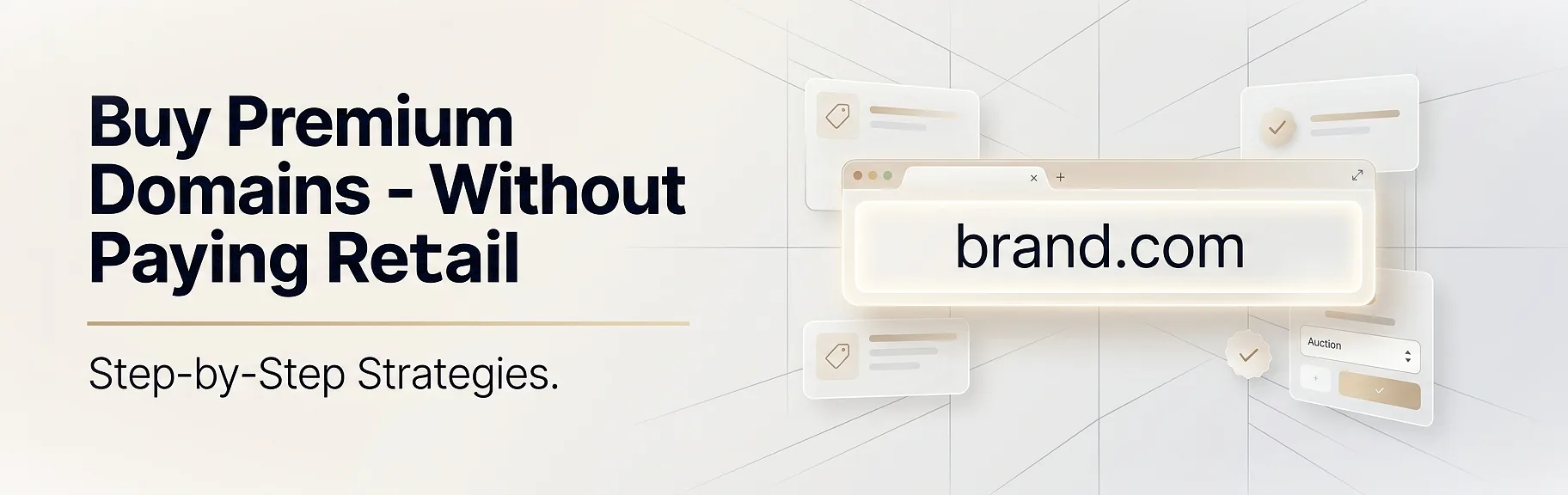
Acquiring a premium domain at below-market cost requires leveraging aftermarket auction platforms, backordering expiring domains, and direct seller negotiation – strategic alternatives to retail registrar pricing that routinely inflate valuations by 200-500% above fair market value. The key mechanisms include expired domain auctions (GoDaddy Auctions, NameJet, DropCatch), private acquisition via broker intermediaries, and secondary marketplace bidding on platforms like Sedo or Dan.com, each offering distinct pricing leverage points. Understanding domain appraisal methodologies, scarcity signals, and negotiation timing gives buyers a structural advantage in securing high-value .com or niche TLD assets at fractions of their listed retail price.
If you have been eyeing a short, memorable domain but walked away when you saw the price tag, you are not alone. The good news is: retail price is rarely the only price. With the right approach, knowing how to buy a premium domain cheap becomes less about luck and more about strategy, timing, and market knowledge.
Looking to secure a premium domain at a fraction of the cost? The sections below walk you through every proven method, step by step.
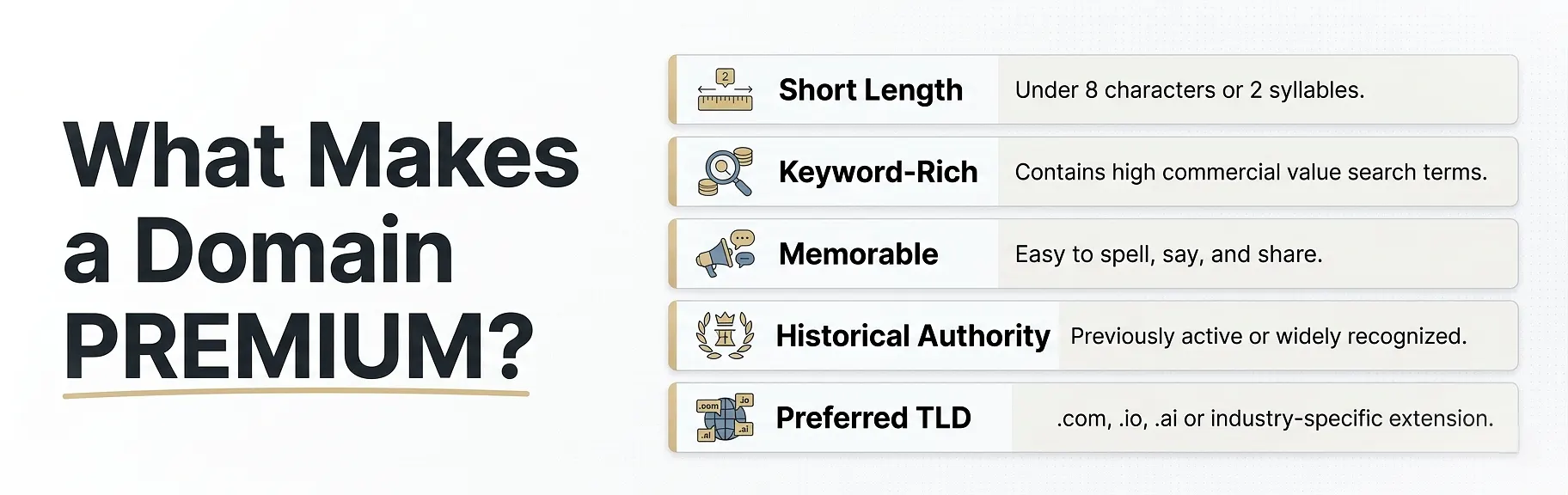
What is a Premium Domain Name?
A premium domain name is a short, keyword-rich, or highly memorable web address that commands above-average market value due to its commercial appeal, SEO potential, or brandability. These domains are typically:
- Short: One to two syllables or fewer than eight characters
- Keyword-relevant: Contains high-value search terms
- Easy to remember: Pronounceable, spellable, and intuitive
- Historically significant: Previously used or widely recognized domains
- Restricted TLDs: .com, .io, .ai, or industry-specific extensions
Premium domains are not just vanity assets. Research consistently shows that exact-match or partial-match domain names contribute to higher click-through rates in search results, improved brand trust, and stronger Type-In traffic – visitors who arrive simply by guessing a URL.
The challenge is that premium domains are finite. Unlike content or products, the supply of desirable domain names is fixed. Once a great .com is registered, it does not come back to market unless its owner actively sells it or stops renewing it.
Why Premium Domains Cost So Much at Retail
Understanding why retail prices are inflated helps you identify where the real deals live.
Registrar Markup on Premium Listings
Major registrars like GoDaddy, Namecheap, and Google Domains use automated valuation systems to price premium domains. These systems often overestimate value based on keyword search volume, character length, and comparable sales – without accounting for actual buyer demand at that moment.
Registry-Level Premium Tiers
Some domain registries (especially for newer TLDs like .io or .ai) charge recurring premium renewal fees. This inflates both the initial purchase price and the long-term cost of ownership.
Aftermarket Seller Anchoring
Sellers on platforms like Sedo or Afternic often anchor their asking prices to historical comparable sales, which may reflect peak market conditions from years ago. The listed price frequently has 30-60% negotiation room built in.
Broker Commission Structures
When you buy through a traditional domain broker, their commission (typically 10-20%) is baked into the acquisition cost. This is avoidable when you buy through the right channels.
The takeaway: retail price is a starting point, not a ceiling. Knowing this is the first step toward learning how to buy a premium domain cheap.
How to Buy a Premium Domain Cheap: 7 Proven Strategies
Strategy 1: Shop the Aftermarket Auctions
Domain auction platforms are where the smartest buyers operate. Auctions introduce price discovery based on actual competitive demand rather than artificial retail markups.
Top aftermarket auction platforms:
- GoDaddy Auctions – the largest volume platform for expiring and listed domains
- NameJet – strong for .com and legacy domain inventory
- DropCatch – specialized for catching expiring domains the moment they drop
- Sedo – European-focused with a global inventory of privately listed domains
- Dan.com – clean buyer experience with payment plan options
Setting up alerts on these platforms for your target keywords costs nothing and can surface opportunities that never appear at retail.
Strategy 2: Target Expiring and Expired Domains
Millions of domain names expire every year because their owners forget to renew, let businesses lapse, or simply lose interest. These domains re-enter the market at standard registration prices – even when they carry significant historical value.
How to find expiring domains:
- Use tools like ExpiredDomains.net to filter by extension, age, backlink profile, and keyword
- Monitor GoDaddy’s Closeout section for unsold auction domains dropping to $10-$25
- Set up backorder services (SnapNames, Pool.com) to automatically bid when a domain drops
This approach is one of the most effective ways to acquire how-to-buy-premium-domain-cheap opportunities without competing against large institutional buyers.
Strategy 3: Make a Direct Offer to the Owner
Many premium domains sit parked with no active for-sale listing. The owner may not be actively trying to sell but could be open to an offer.
Steps to contact an owner directly:
- Run a WHOIS lookup to find registrant contact details (use ICANN WHOIS at lookup.icann.org)
- If privacy protection is enabled, use the registrar’s contact forwarding form
- Draft a low-key, professional inquiry – do not reveal your urgency or maximum budget
- Open with a reasonable below-market offer (typically 40-60% of estimated value)
- Be prepared to wait; sellers often take days or weeks to respond
Direct outreach has no platform fees and no competing bids, which makes it structurally the cheapest acquisition channel when it works.
Strategy 4: Use a Domain Broker Strategically
While brokers charge commissions, they can still save you money by:
- Anonymizing your identity – Sellers often inflate prices when they know the buyer is a funded startup or established brand
- Leveraging established relationships – Experienced brokers know sellers personally and can unlock off-market pricing
- Handling valuation and negotiation – A skilled broker prevents emotional overpayment
Look for brokers with published track records and transparent fee structures. A 10% commission on a $2,000 negotiated deal is far cheaper than paying a $4,000 retail asking price.
Strategy 5: Monitor Domain Auctions for Motivated Sellers
Not all auction listings end with a bid. Domains that fail to sell at auction are often listed at significantly reduced buy-it-now prices afterward. Sellers who have run multiple unsuccessful auctions are typically motivated to accept lower offers.
Watch for:
- No-reserve auctions – These must sell to the highest bidder regardless of price
- Expiring listings – Sellers who are about to renew may prefer a quick sale
- Aged listings – Domains that have been on the market for 6+ months without selling
Strategy 6: Negotiate Payment Plans
Several platforms and individual sellers offer installment payment options, which reduce the immediate financial burden without reducing the domain’s value to you.
Dan.com’s “Lease to Own” feature allows buyers to make monthly payments while using the domain immediately. This approach is ideal for startups and small businesses that need a premium domain now but prefer to spread the cost over 12-24 months.
Strategy 7: Buy from Distressed or Liquidating Portfolios
Domain investors who are liquidating large portfolios often sell assets at steep discounts to convert inventory to cash quickly. These opportunities surface on:
- Domain investor forums like NamePros and DNForum
- Social platforms where investors post bulk-sale announcements
- Direct listings on Dan.com and Sedo with “make offer” pricing
Portfolio sellers often prioritize speed over maximizing price per domain, which creates room for buyers to acquire premium names at 20-50% of typical market value.
Step-by-Step Guide to Buying Through Domain Auctions
Auction platforms are the most accessible entry point for buyers learning how to buy a premium domain cheap. Here is the full process:
Step 1: Create accounts on major platforms Register on GoDaddy Auctions, Sedo, and Dan.com. Verification may take 24-48 hours, so do this before you find your target domain.
Step 2: Define your target criteria Decide in advance on your maximum bid, desired keywords, preferred TLDs, and acceptable character length. Do not let auction excitement override your pre-set limits.
Step 3: Research comparable sales Use NameBio.com to search historical domain sales for comparable assets. This reveals what buyers actually paid, not what sellers asked.
Step 4: Set up keyword alerts Most auction platforms allow you to save search filters and receive notifications. Set alerts for your target keywords across multiple platforms simultaneously.
Step 5: Monitor auction timelines End-of-auction timing matters. Auctions that end at low-traffic times (early morning, weekends) often attract fewer bids and close at lower prices.
Step 6: Bid strategically Use the auction platform’s maximum-bid proxy system. Do not manually bid in increments, as this signals active interest and can drive up prices. Place your maximum and step back.
Step 7: Complete the transfer Once you win, follow the platform’s escrow and transfer process. Use ICANN’s transfer protocols to ensure the domain is fully pushed to your registrar account before releasing payment.
How to Negotiate a Premium Domain Price Directly
Direct negotiation is an art form that can save thousands of dollars. Before you reach out to a seller, understand the core principles:
Anchor Low Without Offending
Your first offer sets the psychological anchor for the entire negotiation. Start at 40-50% of your actual maximum. This gives you room to move while making the seller feel they are winning ground.
Justify Your Offer With Data
Reference comparable sales from NameBio or domain appraisal data to frame your offer as market-informed rather than arbitrary. Sellers respect buyers who have done their research.
To better understand how domain values are algorithmically assessed, reviewing how domain appraisal tools calculate premium domain value gives you a data-backed framework to bring to any negotiation.
Use Silence as a Tool
After making your offer, do not follow up within 24-48 hours. Silence creates uncertainty on the seller’s side and often prompts a counter-offer closer to your target price.
Be Willing to Walk Away
The single most powerful negotiating position is genuine willingness to walk away. If a seller knows you need their domain, they will not budge. Maintain the posture of an opportunistic buyer, not a motivated one.
Consider Offering Non-Cash Value
Some sellers will accept partial cash plus equity, backlinks, or consulting in lieu of full purchase price. Explore creative deal structures, especially with individual domain holders who have a business interest beyond the domain itself.
Backorder Strategy: Catching Expiring Premium Domains
Backordering is the process of reserving a registration attempt on a domain before it officially expires. When a domain enters the redemption or pending-delete phase, backorder services compete to register it the moment it becomes available.
How the Process Works
- Identify your target domain – Confirm it is due to expire soon using WHOIS data
- Place a backorder – Services like SnapNames, Pool.com, or GoDaddy Backorder charge $10-$69 per attempt
- Competing backorders trigger auctions – If multiple services have placed orders on the same domain, it goes to a backorder auction
- Single backorders get direct registration – If only one service backorders the domain, they register it directly and transfer it to you at the backorder fee
Backorder Platform Comparison
| PLATFORM | FEE RANGE | AUCTION TRIGGERED IF | SUCCESS RATE |
|---|---|---|---|
| GoDaddy Backorder | $4.99-$24.99 | Multiple backorders | High (large network) |
| SnapNames | $69 | Multiple orders | High (premium domains) |
| DropCatch | $29.99 | Multiple orders | Very high (fast drop catching) |
| Pool.com | $60 | Multiple orders | Moderate |
Backordering is particularly effective for moderately valuable domains where institutional buyers are not yet aware of the pending expiry. Monitoring tools like DomainTools alert you to expiration dates in advance.
Common Mistakes Buyers Make (and How to Avoid Them)
Even sophisticated buyers make costly errors when acquiring premium domains. Avoid these pitfalls:
Mistake 1: Revealing Your Budget or Urgency
Never tell a seller your maximum budget or your deadline for acquiring the domain. Both are leverage weapons they will use against you. Always negotiate from a position of casual interest rather than necessity.
Mistake 2: Skipping the Appraisal Step
Paying retail for a domain without independent appraisal is like buying a car without checking market prices. Use free tools like Estibot or GoDaddy’s domain appraisal tool as baselines, then cross-reference with real sales data from NameBio.
Mistake 3: Ignoring Trademark Conflicts
Before purchasing any premium domain, run a trademark search through the USPTO TESS database (tess2.uspto.gov) or equivalent authority in your country. Acquiring a trademarked domain can expose you to UDRP (Uniform Domain-Name Dispute-Resolution Policy) claims, potentially costing you the domain and your purchase price.
Mistake 4: Skipping Escrow for High-Value Transactions
Never pay a domain seller directly without using an escrow service for transactions above $500. Escrow.com is ICANN-accredited and the industry standard. Escrow protects both parties by holding funds until the domain transfer is confirmed.
Mistake 5: Focusing Only on .com
While .com commands the highest premium, alternatives like .co, .io, .ai, and industry-specific TLDs often offer comparable branding value at a fraction of the price. Depending on your business model, a strong brandable .io or .co may outperform a mediocre .com.
Mistake 6: Overbidding in Competitive Auctions
Auction psychology is real. Once you are competing, the desire to win can override rational valuation. Set your maximum in advance and treat it as a hard ceiling, not a soft guideline.
Expert Tips for Getting the Best Deal
These advanced tactics separate experienced domain buyers from first-timers:
Tip 1: Time Your Offer Around Domain Renewal Dates Sellers approaching annual renewal are more motivated to sell than those who just renewed. Track renewal cycles using WHOIS expiry data and time your outreach accordingly.
Tip 2: Use Multiple Intermediary Identities If you are purchasing a domain for a well-known brand, use an anonymous email address or intermediary to avoid seller price inflation. Sellers routinely charge more when they identify the buyer as a funded company.
Tip 3: Bundle Offers Across Multiple Sellers If a domain investor holds several assets you want, propose a bundle deal. Sellers often accept significantly lower per-domain pricing in exchange for volume – and for liquidating multiple assets in a single transaction.
Tip 4: Research the Seller’s Portfolio History Sellers who have been holding a domain for 5+ years without selling are statistically more likely to accept a lower offer than someone who recently acquired it. Long hold times often signal willingness to exit at below-peak pricing.
Tip 5: Leverage Seasonal Market Timing Domain markets slow in December and August. Sellers tend to be more flexible during slow periods, and fewer competing buyers mean lower auction closing prices. Plan major acquisitions around these windows when possible.
Tip 6: Understand Algorithmic Valuation Signals Domain appraisal tools factor in metrics like domain age, backlink authority, keyword CPC, and brandability scores. Understanding these signals helps you identify undervalued domains that algorithms have not yet priced upward.
Comparison Table: Premium Domain Buying Channels
| BUYING CHANNEL | AVERAGE COST VS. RETAIL | TIME TO ACQUIRE | BEST FOR | KEY RISK |
|---|---|---|---|---|
| Retail Registrar | 100% (full price) | Instant | Exact new registrations | Overpriced premiums |
| Aftermarket Auction | 40-80% of retail | 1-7 days | Competitive domain hunting | Overbidding |
| Direct Owner Outreach | 30-60% of retail | 2-8 weeks | Parked/unlisted domains | Seller unresponsive |
| Backorder Services | 5-20% of retail | 1-90 days | Expiring domains | Uncertain availability |
| Domain Broker | 50-90% of retail | 1-6 weeks | High-value acquisitions | Broker fees |
| Portfolio Liquidation | 20-50% of retail | 1-3 days | Bulk or motivated sellers | Limited selection |
| Payment Plan (Lease-to-Own) | Full price over time | Immediate use | Cash-flow-constrained buyers | Total cost unchanged |
FAQ
What is the cheapest way to buy a premium domain name?
The cheapest method is backordering an expiring domain. When only one backorder service has placed an order, you can acquire the domain at the backorder fee (as low as $5-$30), regardless of its market value. The next most cost-effective approach is direct owner outreach on unlisted parked domains, where you can often negotiate to 30-50% of fair market value.
How do I know if a premium domain is priced fairly?
Cross-reference at least three data points: automated appraisal tools (Estibot, GoDaddy Appraisals), comparable sales data from NameBio.com, and active listings on aftermarket platforms like Sedo or Dan.com. If the asking price exceeds the median of recent comparable sales by more than 30%, the domain is overpriced.
Can I negotiate the price of a premium domain?
Yes, and in most cases you should. Sellers on aftermarket platforms routinely accept 20-50% below their listed asking price, particularly for domains that have been listed for a long time without selling. Direct negotiation with private owners can yield even larger discounts, especially when you anchor early with a data-backed below-market offer.
Is it safe to buy a premium domain from a private seller?
It is safe when you use a reputable escrow service. Escrow.com is the ICANN-accredited standard for domain transactions. Never transfer money directly to a seller before the domain has been pushed to your registrar account. The escrow service holds your funds in trust until transfer is confirmed by both parties.
What is the best platform for buying a premium domain cheap?
For expired domains, GoDaddy Auctions and DropCatch offer the largest inventory and the most competitive pricing. For private listings, Dan.com and Sedo are the most transparent in terms of pricing data and buyer protections. For direct outreach on unlisted domains, ICANN WHOIS is your starting point for owner contact information. Learning how to buy a premium domain cheap often means using multiple platforms simultaneously for maximum coverage.
How long does a domain auction take?
Domain auctions typically run for 1-7 days on most platforms. Expired domain drop auctions may last only 24-48 hours after a domain officially drops. Backorder auctions among competing services are usually resolved within 2-5 days after the drop date. Factor this timeline into your acquisition planning, especially if you have a business launch deadline.
Do premium domains help with SEO?
Keyword-rich premium domains can provide indirect SEO benefits, including improved click-through rates in search results, higher brand recall driving branded search volume, and in some cases partial exact-match keyword signals. However, domain SEO value is secondary to content quality and backlink authority in Google’s current algorithm. The primary value of a premium domain is commercial and brand-driven, not purely technical SEO.
Conclusion
Paying retail for a premium domain is optional, not mandatory. The secondary market, expiring domain auctions, direct negotiation, and backorder strategies give buyers multiple structured pathways to secure high-value domain assets at significantly reduced cost. The difference between buyers who overpay and buyers who do not comes down to preparation: knowing the real market value, understanding seller psychology, and using the right acquisition channel for each situation.
Whether you are launching a startup, rebranding an existing business, or building a domain portfolio, the strategies outlined here give you a concrete roadmap for how to buy a premium domain cheap – without compromising on quality or domain authority.
Ready to start your search on a platform built specifically for buyers who value quality without inflated pricing? Explore low-cost inexpensive premium domains and find your perfect domain at a price that makes business sense.