Domain appraisal tools calculate premium domain appraisal cost by combining algorithmic scoring across comparable sales data, keyword commercial intent, TLD authority weighting, character length, and brandability indexes – producing an estimated market value range rather than a fixed price. These automated systems rely heavily on historical aftermarket transaction records from platforms like Afternic, Sedo, and NameBio, cross-referenced against current search volume metrics and domain age signals. However, because these models are trained on past sales and cannot account for real-time market sentiment, niche-specific demand spikes, or the subjective brand equity that a specific buyer assigns to a domain, their valuations frequently diverge from actual transaction prices by 30% to 200% or more.
If you’ve ever run a domain through an appraisal tool and wondered why the number feels arbitrary, you’re not imagining it. The methodology behind these valuations is more complex than most buyers realize – and the gaps in that methodology can cost you real money, whether you’re buying, selling, or building a strategy around domain assets.
In this guide, we break down exactly how these tools work, where they fall short, and how to approach domain valuation with the rigor it deserves.
How Domain
Appraisal
Tools
Calculate
Value
What is a Premium Domain Appraisal?
A premium domain appraisal is a formal or algorithmic assessment of a domain name's market value. Unlike standard domains priced at registration cost, premium domains carry inherent commercial value based on their memorability, keyword strength, brandability, and scarcity.
The premium domain appraisal cost itself refers to two things depending on context:
- The fee charged to receive a professional or tool-based valuation report.
- The estimated market price the domain commands in a sale or acquisition scenario.
Understanding the difference between these two definitions is critical before you engage any appraisal service or platform.
Quick Definition: A premium domain is typically a short, memorable, keyword-rich, or brandable domain name that commands a price above standard registration fees - often ranging from a few hundred to several million dollars.
How Domain Appraisal Tools Calculate Value: The Core Methodology
6 Factors That
Determine Premium
Domain Value
Comparable Sales
Analyses recent transactions of similar domain names.
Keyword CPC
Measures the cost-per-click for keywords in the domain.
TLD Authority
Measures the cost-per-click for keywords in the domain.
Domain Length
Measures the length of the marries in the domain.
Brandability
Measures the cost-per-click for keywords in tn domain/ eronails.
Domain Age
Measures that age developed over years or domain.
1. Comparable Sales Data (Comps)
The most foundational input for any automated domain valuation is comparable sales data. Tools pull transaction records from major domain marketplaces and compile a dataset of what similar domains have sold for historically.
Key data sources include:
- NameBio - one of the largest public databases of domain sale transactions
- Afternic - GoDaddy's premium domain marketplace, with extensive sales history
- Sedo - a major international domain marketplace with its own transaction records
- DAN (Domain Active Nameservers) - marketplace data on completed transfers
The algorithm then identifies domains with similar characteristics to the one being appraised - matching on length, TLD, keyword type, and structure - and builds a value range from those comps.
The limitation: Comparable sales data is inherently backward-looking. A domain that sold for $5,000 two years ago may be worth $25,000 today if the keyword has surged in commercial relevance. Conversely, industries that have contracted make historical comps misleading in the other direction.
2. Keyword Commercial Intent and Search Volume
Most appraisal tools integrate data from Google Keyword Planner or third-party SEO tools such as Ahrefs or SEMrush. They assess:
- Monthly search volume for the exact keyword phrase in the domain
- Cost-per-click (CPC) values as a proxy for commercial intent
- Keyword competition level among advertisers
A domain like FastCarInsurance.com would score highly here because "car insurance" carries exceptional CPC values, indicating that businesses in that industry will pay premium prices to own the exact-match keyword real estate.
The limitation: High search volume and CPC don't automatically translate into high domain value for every use case. A domain that matches a high-CPC keyword may still be unmarketable if the phrase is awkward as a brand name, if the niche is hyper-local, or if the industry has shifted to long-tail search behavior.
3. TLD (Top-Level Domain) Authority Weighting
Every appraisal tool assigns a multiplier based on the domain's TLD. The hierarchy typically looks like this:
| TLD | Value Multiplier | Notes |
|---|---|---|
| .com | 1.0x (baseline) | Universally highest value |
| .io | 0.6x - 0.8x | Strong in tech/startup sectors |
| .co | 0.5x - 0.7x | Widely recognized alternative |
| .net | 0.3x - 0.5x | Declining premium in most niches |
| .org | 0.2x - 0.4x | Strong only for nonprofits |
| Country-code TLDs | Variable | Highly dependent on geography |
The limitation: These multipliers are averages. In specific industry contexts, a .io domain can command more value than a .com because of strong sector-specific brand associations. The blanket TLD weighting doesn't capture this nuance.
4. Domain Length and Structure
Shorter domains are consistently more valuable. Appraisal tools apply length-based scoring that typically follows this pattern:
- 1-3 characters: Extremely rare, exceptionally high value (LLL.com or NNN.com three-character domains)
- 4-6 characters: Strong premium tier, especially for pronounceable brandable names
- 7-10 characters: Solid mid-range, especially with keyword alignment
- 11-15 characters: Standard range, value increasingly dependent on keyword strength
- 16+ characters: Declining value unless very specific commercial keyword match
Beyond raw length, algorithms also assess:
- Number of words (one-word vs. two-word vs. hyphenated)
- Presence of hyphens (negative signal)
- Presence of numbers (generally a negative signal unless contextually relevant)
- Pronunciation ease
5. Brandability and Memorability Scoring
This is where appraisal tools attempt to quantify the subjective. Brandability scoring typically measures:
- Pronounceability - can a human say it easily?
- Spellability - is it spelled the way it sounds?
- Uniqueness - is the word invented (like "Google" or "Zappos") or dictionary-based?
- Extension fit - does the TLD complement the name naturally?
Some tools use linguistic modeling or trained machine learning models to score brandability. Others rely on simpler heuristics.
The limitation: Brandability is ultimately a human judgment. No algorithm has successfully replicated the intuitive brand resonance that domain buyers and brand strategists assess when evaluating a name's long-term commercial potential.
6. Domain Age and Historical Usage
Older domains with clean backlink histories often carry additional value signals:
- Age: Established domains with years of registration history may carry residual SEO authority.
- Traffic history: If a domain previously hosted a live website with organic traffic, that history can influence appraisal positively.
- Backlink profile: Domains with high-authority inbound links from reputable sources hold additional SEO asset value.
- Penalty history: Conversely, domains previously penalized by Google for spam or manipulative SEO tactics lose value significantly.
Comparison: Popular Domain Appraisal Tools and Their Methodologies
The Data Behind Domain Valuations
Recent Comparable Domain Sales
Sale Price vs. Keyword CPC Correlation
| Tool | Data Sources | Brandability Scoring | Real-Time Market Data | Reliability Rating |
|---|---|---|---|---|
| GoDaddy Appraisal | Internal sales + third-party | Basic heuristics | Partial | Moderate |
| Estibot | NameBio + SEO tools | Keyword-heavy | Limited | Moderate |
| DomainIndex | Multi-source comps | Moderate | Partial | Moderate-High |
| Afternic Valuation | Afternic sales data | Limited | Partial | Moderate |
| Sedo Appraisal | Sedo + partner data | Moderate | Limited | Moderate |
Note: No single tool provides a definitive valuation. Cross-referencing multiple tools is consistently recommended by domain investment professionals.
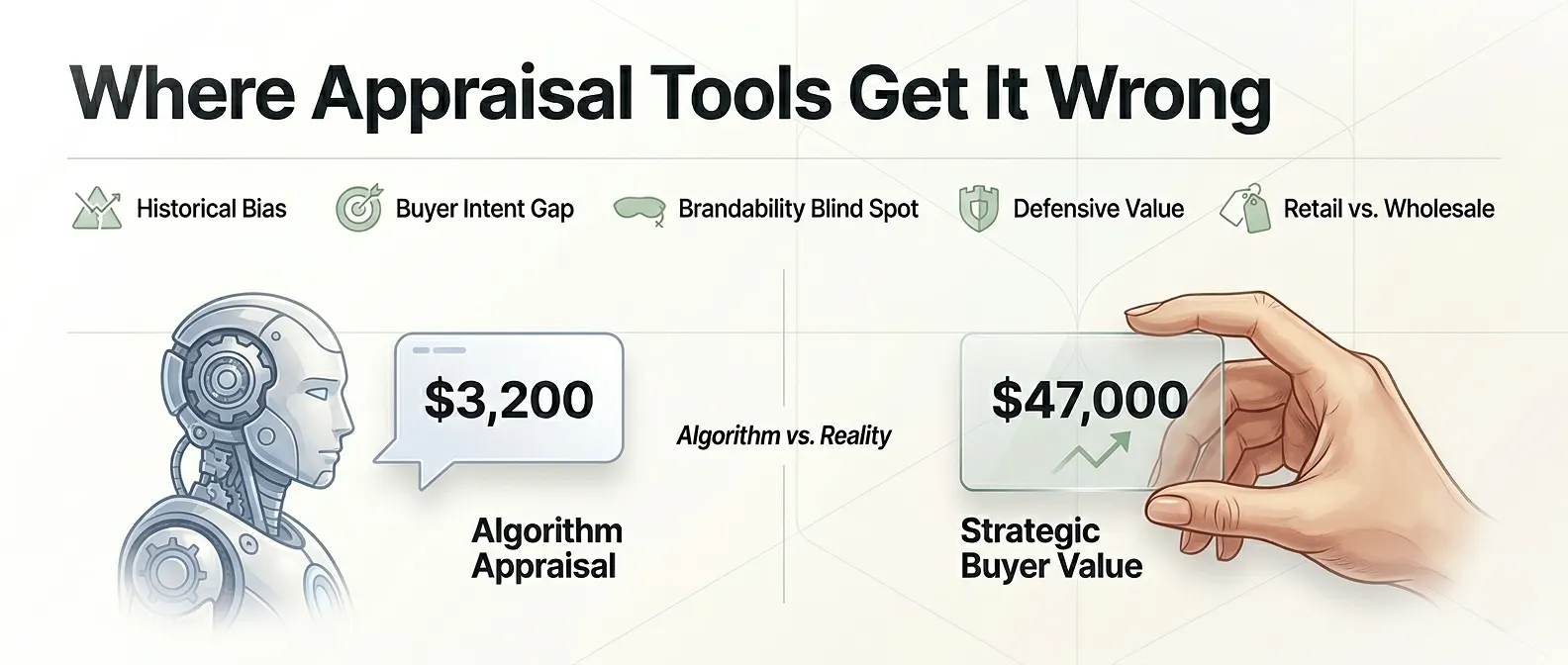
Where Domain Appraisal Tools Get It Wrong
This is the critical section most buyers and sellers skip - and it's where the real money is either made or lost.
Mistake 1: Overweighting Historical Sales in Rapidly Changing Markets
The AI tools and SaaS platforms that have reshaped entire industries over the last three years have created massive demand spikes for domains in categories that simply didn't register as commercially significant five years ago. Domains related to generative AI, decentralized finance, no-code development, and remote work infrastructure have appreciated dramatically in ways that historical comps cannot capture.
Mistake 2: Ignoring Buyer-Specific Premium
A domain's value is never fixed - it's contextual. GlobalPharmaDistribution.com may appraise at $2,000 algorithmically, but to a pharmaceutical logistics company entering a new international market, that domain could represent $50,000 or more in brand positioning value. Appraisal tools cannot model the intent or urgency of a specific buyer.
Mistake 3: Failing to Account for Defensive Registration Value
Large enterprises routinely purchase premium domains they have no immediate plans to use - purely to prevent competitors from acquiring them. This defensive premium is invisible to appraisal algorithms but very real in transaction negotiations.
Mistake 4: Generic Keyword Bias
Tools calibrate heavily toward generic, high-volume keywords. This means highly brandable, invented words that don't match any search keyword - think Stripe, Slack, or Figma before those brands existed - would receive undervalued appraisals. Pure brandability value is consistently underweighted.
Mistake 5: Not Distinguishing Between Retail and Wholesale Value
Domain appraisal tools typically estimate retail market value - what a domain might sell for on an open marketplace at peak. But for buyers, the relevant figure is often acquisition cost, which in the aftermarket can be significantly negotiated down. For sellers, time-to-sale is a variable that appraisals never address.
How to Evaluate Premium Domain Appraisal Cost Accurately: A Practical Framework
Rather than relying on a single tool's output, use this multi-point assessment process:
Your 6-Step Domain Valuation Framework
Run 3 Tool Appraisals
Input domain into three top appraisal tools for initial data.
Manual Comps Research
Compile manual comp research corners.
Keyword CPC Analysis
Analyses your keyword CPC analysis.
Industry Trend Context
Enreliuar industry trend context and trends.
Brand Fit Check
Clbocit brand and fit check.
Set a Value Range
Define your negotiation ceiling and floor.
Step 1: Run Three Independent Tool Appraisals
Use GoDaddy, Estibot, and one additional tool. Note the range, not the average. A wide spread indicates high valuation uncertainty; a tight spread suggests more reliable consensus.
Step 2: Manual Comparable Sales Research
Visit NameBio and manually search for domains with similar keyword, length, and TLD characteristics. Prioritize sales from the last 12-18 months over older records.
Step 3: Keyword Commercial Intent Analysis
Pull CPC and monthly search volume data for the primary keyword in the domain. Use tools like Ahrefs Keywords Explorer or Google Keyword Planner. High CPC with moderate-to-high volume is the strongest indicator of commercial domain value.
Step 4: Industry and Trend Context Assessment
Evaluate whether the domain's keyword or theme is in a growth industry, a stable industry, or a declining sector. A domain in a rapidly growing niche deserves a forward-looking premium that historical tools won't apply.
Step 5: Brand Fit and Competitive Intelligence
Search whether any companies are currently using similar names, whether the .com version is already taken with an active business, and whether the domain would create confusion or has trademark risks.
Step 6: Set a Value Range, Not a Fixed Number
Sophisticated domain buyers and investors never work with a single price point. They define:
- Floor value: Minimum acceptable price based on conservative comps
- Market value: Estimated open-market transaction price
- Strategic ceiling: Maximum a motivated, specific buyer type might reasonably pay
Expert Tips From Domain Investors
Here are insights from established domain investment and acquisition professionals:
- "Trust the methodology, not the output." Appraisal tools are useful for understanding which factors matter rather than treating their specific number as gospel.
- "Recency matters more than volume." A handful of comparable sales from the last six months outweigh dozens of older transactions in predictive accuracy.
- "CPC is a signal, not a verdict." High-CPC keywords indicate commercial interest, but actual domain value depends on whether that keyword translates into a marketable brand name.
- "Premium doesn't always mean expensive." Some of the most valuable domain acquisitions happen when buyers find genuinely premium-quality domains priced at near-standard rates - often because the current owner doesn't recognize their asset's value, or because the domain sits on a lesser-known marketplace.
This last point is especially relevant for businesses and developers looking to acquire premium domains cheap without compromising on quality or commercial potential.
The Real Cost of a Premium Domain Appraisal
When evaluating the actual premium domain appraisal cost you might pay as a buyer or seller, here's what the market looks like:
| Appraisal Type | Typical Cost | Best For |
|---|---|---|
| Free automated tools (GoDaddy, Estibot) | $0 | Quick reference, initial screening |
| Paid automated report (enhanced) | $15 - $75 | More detailed algorithmic data |
| Broker-assisted appraisal | $100 - $500 | Pre-sale valuation, negotiation support |
| Independent certified appraisal | $300 - $1,500+ | Legal disputes, acquisitions, financing |
| Full domain investment due diligence | $500 - $3,000+ | Large-scale acquisitions, portfolio deals |
For most individual domain acquisitions, free tools supplemented by manual comparable sales research provide sufficient intelligence. Paid appraisals become valuable when the acquisition price justifies the cost of additional validation.
Common Mistakes Buyers Make After Getting an Appraisal
- Treating the appraisal as a fixed price. An appraisal is a reference point, not a ceiling or floor for negotiation.
- Ignoring the seller's context. A seller under financial pressure or with a portfolio to manage may accept significantly below appraised value.
- Over-relying on .com bias. For certain tech, startup, or international use cases, alternative TLDs can deliver equal or superior brand value at a fraction of the premium domain cost.
- Skipping trademark screening. A domain that appraises at high value but carries trademark risk is a liability, not an asset. Always run USPTO and international trademark searches before completing any acquisition.
- Not factoring in renewal costs. Some premium domain owners use annual renewal pricing as an ongoing leverage mechanism. Multi-year buyout negotiations can mitigate this exposure.
- Missing low-cost premium opportunities. Not every premium-quality domain is listed at a premium price. Platforms offering low-cost inexpensive premium domains can surface genuine value that overpriced marketplaces miss entirely.
Frequently Asked Questions (FAQ)
What is premium domain appraisal cost?
Premium domain appraisal cost refers to either the fee charged for a domain valuation service (ranging from free to $3,000+ depending on the appraisal type) or the estimated market value a premium domain commands in a sale or acquisition.
How accurate are free domain appraisal tools?
Free tools like GoDaddy's automated appraisal or Estibot provide useful baseline estimates but carry significant margin of error - often 30% to 200% or more from actual transaction prices. They are best used as initial screening tools rather than definitive valuations.
What factors most affect a premium domain's appraisal value?
The primary factors include: comparable sales history, keyword search volume and commercial intent (CPC), TLD type, domain length, brandability, and domain age/history. Commercial keyword alignment and comparable sales data carry the most algorithmic weight.
Why do two appraisal tools give different values for the same domain?
Different tools use different data sources, weighting algorithms, and training datasets. GoDaddy's appraisal tool draws heavily on its own marketplace data, while Estibot weights keyword CPC more prominently. This is why cross-referencing multiple tools is standard practice among domain investors.
Can I negotiate a premium domain price below its appraised value?
Yes - frequently. Appraisals reflect theoretical market value, not seller motivation. Domain sellers with large portfolios, expiring registrations, or liquidity needs often accept below-appraisal offers. Understanding the seller's context is a core negotiation advantage.
Where can I find premium domains at below-market prices?
Curated marketplaces and specialized registrars that focus on affordable inventory are your best options. Platforms like Aolra specialize in offering premium-quality domains at accessible price points, making quality domain acquisition viable for startups, developers, and small businesses.
Is a paid domain appraisal worth the cost?
For acquisitions under $5,000, free tools supplemented by manual NameBio research is typically sufficient. Paid independent appraisals become cost-justified for acquisitions above $10,000, legal disputes over domain ownership, corporate acquisitions, or domain portfolio financing.
What is the difference between domain appraisal and domain valuation?
The terms are often used interchangeably. Technically, a domain appraisal typically refers to a formal report generated by a tool or professional, while domain valuation is the broader process of determining fair market value using any combination of methods.
Use Appraisal Tools as Intelligence, Not Oracle
Premium domain appraisal tools are powerful starting points. They systematize the most quantifiable factors in domain valuation and help buyers and sellers establish a credible reference range for negotiations. However, their structural limitations - backward-looking data, inability to model buyer-specific intent, and weak brandability assessment - mean that sophisticated market participants never rely on them exclusively.
The most accurate premium domain appraisal cost assessment combines automated tool outputs with manual comparable research, keyword commercial intent analysis, industry trend context, and a clear understanding of your specific use case and strategic value ceiling.
If you're actively looking to acquire premium domain assets at genuine market value, without overpaying for appraisal theater, explore affordable premium domain options at Aolra - where quality domain inventory is curated for buyers who understand that premium doesn't have to mean prohibitively expensive.