Domain investing for beginners is best approached through systematic aftermarket acquisition of short, brandable, or keyword-rich domain names at below-market cost – using secondary marketplaces, expired domain auctions, and direct owner negotiation as primary entry channels rather than retail registrar pricing. Beginner investors can construct a functional starting portfolio for $200-$500 by targeting low-cost premium names in liquid commercial categories such as fintech, health tech, SaaS, and e-commerce, where end-user buyer demand remains consistent and measurable through historical sales data. The asymmetric return structure of domain investing – where a $25 aftermarket acquisition can generate a $2,500 end-user sale – makes it one of the most capital-efficient digital asset classes accessible to investors without a significant starting budget.
Most new investors assume valuable internet real estate is out of reach without deep pockets. The secondary domain market proves otherwise every single day. With the right acquisition methodology, appraisal discipline, and portfolio management habits, domain investing for beginners delivers genuine returns within the first 12-18 months of active operation.
Investors looking for a structured starting point can explore a curated inventory of premium domains at below-retail acquisition cost – built for buyers who prioritize verified value over inflated listing prices.
What is Domain Investing and How Does It Work?
Domain investing – also called domaining – is the practice of acquiring internet domain names at low cost and generating returns through resale, rental income, or domain parking revenue.
The underlying asset logic mirrors physical real estate. Just as property investors acquire undervalued land in high-growth areas, domain investors target undervalued web addresses in high-demand commercial categories. The supply of truly desirable domain names is finite and fixed. New businesses launch every day and each one needs a domain – which sustains consistent end-user buyer demand regardless of broader economic cycles.
The Four-Stage Investment Cycle
Every domain transaction follows a repeatable four-stage structure:
- Research: Identify domains with strong commercial value using keyword data, brandability criteria, and verified comparable sales history
- Acquire: Purchase through an aftermarket auction, expired domain platform, closeout listing, or direct owner negotiation at below-market cost
- Hold or Monetize: Park the domain with pay-per-click advertising while waiting for a buyer, or list it actively across multiple secondary marketplaces
- Exit: Sell to an end-user business at a profit through direct sale, broker-facilitated transaction, or auction platform closing
Each cycle can close in weeks for high-demand liquid domains or take 12-24 months for niche assets. Portfolio volume and pricing discipline are the two variables that most consistently determine whether a beginner investor reaches profitability within their first year.
Is Domain Investing Still Viable in 2025?
Absolutely – and market data confirms it. According to the historical transaction database maintained by NameBio, hundreds of thousands of secondary market domain sales occur annually, with median end-user sale prices for quality .com domains consistently ranging between $1,500 and $15,000. The market remains active because the formation of new businesses never stops, and every new business requires a domain name as a foundational digital asset.
Why Low-Cost Premium Names Are the Smartest Entry Point for Beginners
The majority of domain investing beginners make one of two errors: they target seven-figure single-word .com assets far beyond their budget, or they register low-value generic domains that no business ever wants to buy. Low-cost premium names solve both problems simultaneously.
Defining the Low-Cost Premium Sweet Spot
A low-cost premium domain occupies the space between a generic registration and a flagship market-leading .com. These assets typically share the following profile:
- Acquisition price between $50 and $2,000 on the secondary market
- Two to three syllables forming a natural, brandable name
- A commercially recognized TLD: .com, .co, .io, or .ai
- Keyword relevance to a growing industry or high-value commercial category
- A clean history: no spam flags, no active trademark conflicts, no prior UDRP disputes
This segment generates the most accessible opportunities for domain investing beginners precisely because institutional competition is lower, capital requirements are manageable, and the buyer pool is broad enough to generate sales within a reasonable holding window.
Portfolio Diversification vs. Single High-Ticket Acquisitions
Beginning investors frequently debate whether to buy one $1,000 domain or ten $100 domains. For most beginners, a diversified approach across 10-15 modest-priced assets consistently outperforms concentrated single-asset exposure because:
- It builds appraisal pattern recognition faster across multiple naming types
- It reduces the risk of illiquid capital concentration in one unproven asset
- It raises the statistical probability of achieving at least one profitable exit within 12 months
- It accelerates market learning through broader exposure to buyer inquiry patterns and pricing signals
The Essential Vocabulary Every Domain Investing Beginner Needs
Fluency in domain market terminology is not optional. Every auction listing, transfer agreement, and negotiation email operates in this language – and misunderstanding any term can carry real financial consequences.
| TERM | DEFINITION |
|---|---|
| Registrar | A company authorized by ICANN to register domain names (e.g., Namecheap, GoDaddy) |
| Aftermarket | The secondary market where previously registered domains are resold |
| Drop Catching | Registering a domain the instant it expires and becomes publicly available |
| WHOIS | A public database containing domain ownership, registration, and expiry data |
| Domain Parking | Displaying pay-per-click ads on an undeveloped domain to generate passive revenue |
| Backorder | A service reservation to attempt registration of a target domain upon expiry |
| Escrow | A neutral third party holding payment until domain transfer is confirmed |
| UDRP | ICANN’s Uniform Domain-Name Dispute-Resolution Policy governing trademark claims |
| TLD | Top-Level Domain: the extension following the dot (.com, .io, .ai, .co) |
| End-User | A business purchasing a domain to actively use it rather than resell it |
| Domain Broker | A specialist negotiating acquisitions or sales on behalf of a client |
| Liquid Domain | A domain with reliable, consistent buyer demand that transacts quickly |
Internalizing these definitions before your first acquisition prevents costly misunderstandings during transactions, negotiations, and platform interactions.
How to Source Undervalued Premium Domains
Sourcing is the most consequential skill in domain investing for beginners. The market is efficient in high-visibility segments and surprisingly inefficient in others – and those inefficiencies are where genuine opportunities exist.
Source 1: Expired Domain Auctions
Millions of domain names expire every year. Owners forget to renew, businesses close, or investors abandon underperforming assets. Many of these domains carry real commercial value: strong keyword relevance, established backlink histories, or short memorable names that re-enter the market through auction at prices well below their worth.
Key platforms for expired domain acquisitions:
- GoDaddy Auctions – largest expired inventory in the secondary market
- NameJet – strong inventory of legacy .com and corporate domain assets
- DropCatch – specialized high-speed drop catching for precision acquisitions
- Sedo – European-headquartered platform with extensive global aftermarket listings
Source 2: Closeout Listings
When expired domain auctions close with no bids, platforms typically move unsold inventory to closeout sections where domains sell for $10-$25 regardless of their underlying value. GoDaddy’s Closeout section is consistently one of the richest sourcing environments for low-cost premium domain opportunities available to beginners.
Source 3: Buy-It-Now Marketplace Listings
Platforms like Dan.com and Afternic carry extensive inventories of privately held domains with fixed buy-it-now prices. Many sellers on these platforms have paid annual renewal fees for years and are motivated to exit at or below their asking price. Negotiation room is frequently built into listed prices.
Source 4: Direct Outreach to Parked Domain Owners
Many high-value domains sit parked with no active for-sale listing – displaying only placeholder content or pay-per-click ads. Their owners may not be actively selling but often respond positively to a well-timed professional approach. The process involves:
- Identifying parked domains in your target niche using keyword-based WHOIS searches
- Locating registrant contact details through ICANN’s official WHOIS lookup tool at lookup.icann.org
- Sending a concise, professional inquiry without disclosing your investment intent or maximum budget
- Opening with a below-market offer – typically 40-50% of your estimated fair market value
Direct outreach bypasses all platform fees and competing bids. When it succeeds, it produces the lowest acquisition cost of any available channel.
Source 5: Domain Investor Communities
The community at NamePros is one of the best free resources available for domain investing beginners. Active forum members regularly post domains for sale at below-market prices, contribute peer appraisals, and share real-time intelligence on which niches and naming patterns are generating buyer activity. Participating early accelerates your market education faster than any paid course or guide.
Step-by-Step: Building Your First Domain Portfolio
This is the actionable roadmap for domain investing for beginners starting from zero capital deployment.
Step 1: Establish a Realistic Starting Budget
Begin with $200-$500. This range supports 5-15 initial acquisitions across different price tiers without overconcentrating capital in any single strategy. A sensible first allocation:
- 50% toward expired domain auctions (higher asymmetric upside)
- 30% toward closeout or buy-it-now listings (lower cost, faster experiential learning)
- 20% held in reserve for opportunistic acquisitions during the first 60-90 days
Step 2: Select a Focus Niche
Buying domains without a coherent niche strategy is one of the most common errors beginners make. Instead, identify 1-2 industries where you already possess contextual knowledge. Strong entry niches for current market conditions include:
- Technology products and SaaS platforms
- Finance, fintech, and digital payments
- Health, wellness, and direct-to-consumer medical services
- Real estate technology and property management
- E-commerce, retail brands, and direct-to-consumer products
Niche focus streamlines appraisal, narrows your buyer research, and makes your portfolio more discoverable to industry-specific end-user buyers.
Step 3: Validate Every Acquisition with Comparable Sales Data
Never commit capital without verifying real transaction history. NameBio.com provides a searchable database of hundreds of thousands of verified domain sales. Before acquiring any asset, research:
- Domains with comparable length, keywords, and TLD
- Transactions completed within the last 12-24 months (older data is directionally unreliable)
- End-user sale prices versus investor-to-investor pricing (end-user exits command significantly higher multiples)
Understanding how appraisal tools weight these signals algorithmically is a core competency for any serious beginner. The detailed breakdown of how domain valuation platforms assess commercial worth provides a technical foundation for building appraisal judgment you can apply to every acquisition decision.
Step 4: Establish Accounts on Core Platforms
Create and verify accounts on the following before making your first bid:
- GoDaddy Auctions (expired inventory and auction activity)
- Dan.com or Afternic (listing acquired domains for sale)
- DropCatch or NameJet (backordering expiring target domains)
- Escrow.com (securing all mid-to-high value transactions)
- NamePros (community intelligence and peer appraisal)
Platform verification typically requires 24-48 hours. Complete this process before you identify a specific acquisition target – not after.
Step 5: Execute Your First 3-5 Acquisitions
Your first five domains are primarily educational instruments. Prioritize:
- Names with clear, identifiable commercial keywords
- Domains a specific category of business would plausibly want to own
- Clean histories: no spam blacklisting, no trademark conflicts, no prior UDRP actions
- Reasonable ongoing renewal costs (avoid premium-renewal TLDs above $30 per year)
Step 6: List Every Domain Immediately on Multiple Platforms
Too many beginners acquire domains and then list nowhere. List every acquired asset on at least two secondary marketplaces immediately after transfer. Base your asking price on comparable sales data – not on what you wish the domain were worth. A domain priced at 3x fair market value generates zero inquiries; one priced at 1.2x generates real offers within weeks.
Step 7: Track Performance and Iterate Every 90 Days
Maintain a simple acquisition tracker documenting:
- Domain name and TLD
- Acquisition date and total cost
- Annual renewal fee
- Listing platforms and current asking price
- Inbound inquiries and offer history
- Comparable sales updates refreshed quarterly
After 90 days, review which domains generated inquiry activity and which received none. Renewal costs compound annually; domains attracting zero interest after 12-18 months should be evaluated for deletion rather than indefinite renewal.
How to Appraise a Domain Before You Commit Capital
Overpaying on acquisitions is the primary mechanism through which beginners lose money in domain investing. A structured four-point appraisal process protects your capital on every transaction.
The Four-Point Appraisal Framework
Point 1: Comparable Sales Analysis Search NameBio for domains with analogous length, keyword composition, and TLD. Calculate the median confirmed sale price from the last 12 months of comparable transactions. This is your most reliable and defensible data point.
Point 2: Keyword Commercial Value Assessment Look up the primary keyword(s) in Google Keyword Planner or a paid SEO tool. Cost-per-click values above $3-$5 signal that advertisers pay to reach audiences searching this term – a direct indicator that commercially motivated buyers exist in this space.
Point 3: Brandability Scoring Evaluate the domain against four criteria:
- Is it easy to spell correctly after hearing it spoken aloud?
- Is it intuitive to pronounce after reading it?
- Does it suggest a meaning or evoke an identity relevant to a business?
- Is it free of hyphens, numbers, and non-standard character combinations?
Point 4: Automated Appraisal Cross-Validation Use Estibot or GoDaddy’s domain appraisal tool as a directional reference – never as a primary valuation source. These tools provide algorithmic estimates that are useful for baseline validation but frequently fail to capture contextual brandability signals, emerging trend value, or buyer-side demand intelligence that experienced investors recognize. A full technical explanation of what these automated valuation systems actually calculate is worth reviewing before your first significant acquisition.
Monetization Models: How Domain Investors Generate Returns
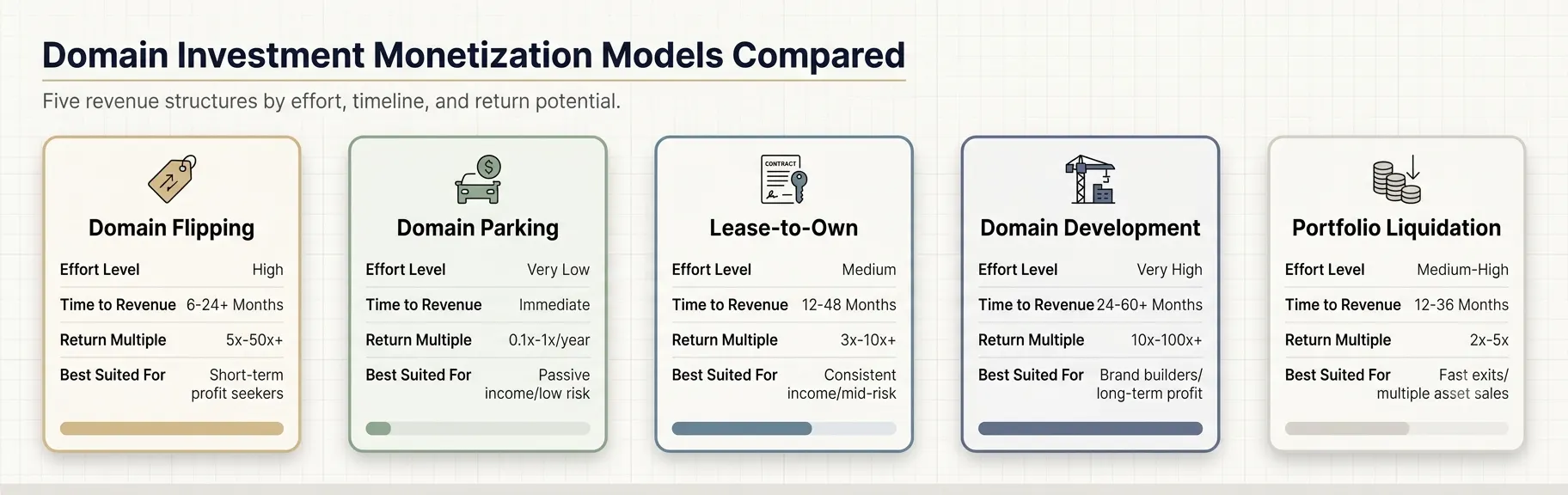
Domain investing for beginners extends well beyond the traditional buy-and-flip transaction model. Five distinct monetization structures exist, each with a different risk, effort, and return profile.
Model 1: Domain Flipping
Acquire at $20-$500; sell to an end-user business at $500-$10,000. This is the most accessible model for beginners. Margin is determined by acquisition cost, holding period, and how effectively you identify and reach potential end-user buyers.
Model 2: Domain Parking
Park undeveloped domains with a parking service such as Sedo Parking, ParkingCrew, or Google AdSense for Domains. Type-in traffic and search referral visits generate pay-per-click ad revenue. Parking income is modest for most domains (a few dollars monthly) but offsets annual renewal costs while you wait for a sale.
Model 3: Lease-to-Own Financing
Rather than selling outright, structure a lease-to-own arrangement through platforms like Dan.com. The buyer makes monthly installment payments while using the domain immediately; full ownership transfers upon the final payment. Lease-to-own structures typically yield 20-30% more total revenue than outright sales because they lower the buyer’s upfront commitment barrier.
Model 4: Domain Development
Build a minimal content site on the domain, generate organic search traffic, and monetize through advertising or affiliate revenue before selling the domain plus website as a combined traffic asset. Developed domains with documented traffic histories command significantly higher transaction multiples than undeveloped assets at equivalent domain quality.
Model 5: Portfolio Liquidation Sales
As your holdings grow, institutional buyers and domain fund managers may approach you regarding bulk acquisition. Portfolio sales price individual assets below their standalone value but deliver immediate liquidity across many domains in a single transaction – valuable when you need to reallocate capital efficiently.
Monetization Model Comparison Table
| MODEL | EFFORT LEVEL | TIME TO REVENUE | AVG. RETURN MULTIPLE | BEST SUITED FOR |
|---|---|---|---|---|
| Domain Flipping | Low | 1-18 months | 5x-50x acquisition cost | All beginners |
| Domain Parking | Minimal | Immediate (low yield) | 0.5x-2x annually | Large-volume portfolios |
| Lease-to-Own | Moderate | 12-24 months | 20-30% premium on sale price | Mid-value premium names |
| Domain Development | High | 3-12 months | Variable, traffic-dependent | Content-skilled investors |
| Portfolio Liquidation | Low | Immediate at scale | Below per-unit sale value | Capital reallocation events |
Common Mistakes That Cost Beginners Real Money
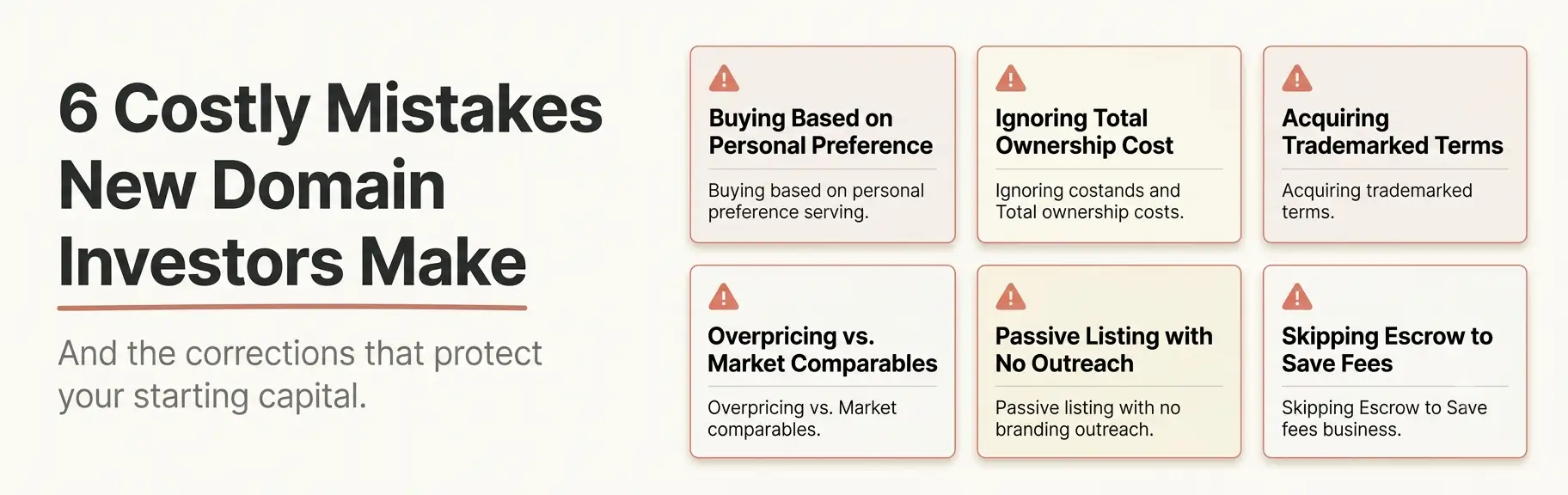
Understanding where new domain investors consistently go wrong saves both capital and time. These six mistakes appear in nearly every beginner portfolio.
Mistake 1: Buying Based on Personal Preference
Personal opinion is irrelevant in domain investing. A name you find creative or clever has no market value unless a business with purchasing power specifically wants it. Before every acquisition, ask one question: “Which type of business would pay money for this domain, and why would they need it?”
Mistake 2: Ignoring the Total Cost of Ownership
A domain that costs $12 to register but $80 per year to renew (common with premium TLD pricing tiers) will erode your portfolio’s financial health rapidly if it fails to sell. Calculate the total ownership cost across a realistic 2-3 year holding window before every acquisition decision.
Mistake 3: Acquiring Trademarked Terms
Registering a domain containing an active third-party trademark is not merely unwise – it constitutes a UDRP policy violation that can result in losing the domain, forfeiting your acquisition cost, and receiving no legal remedy. Always run a trademark verification through the USPTO database before acquiring any domain with brand-adjacent terminology.
Mistake 4: Overpricing Relative to Market Comparables
Beginner investors routinely price domains based on what they paid rather than what the market supports. If you acquired a domain for $100, pricing it at $10,000 without comparable sales support guarantees it will never transact. Competitive pricing at 1.2-2x verified fair market value generates exponentially more buyer inquiries and actual closed sales.
Mistake 5: Passive Listing Without Active Buyer Outreach
Listing a domain and waiting is not a strategy; it is hope. Active monetization requires:
- Identifying businesses in your domain’s niche and sending professional outreach emails
- Posting inventory in domain investor communities and niche-specific forums
- Refreshing marketplace listings periodically to maintain algorithm visibility
Mistake 6: Skipping Escrow to Avoid the Transaction Fee
Any domain transaction above $200 warrants escrow protection. Escrow.com is ICANN’s accredited standard for domain transactions. Bypassing the 0.89-3.25% escrow fee to save a few dollars on a $1,000 sale exposes you to complete capital loss if either party fails to perform. The fee is insurance – not overhead.
For a complementary perspective on how professional buyers structure acquisitions to minimize both cost and risk, the guide on acquiring premium domain assets below standard market pricing covers the full range of acquisition tactics in practical detail.
Expert Tips for Accelerating Early Portfolio Growth
These advanced practices separate investors who build compounding portfolio returns from those who stall after their first few acquisitions.
Tip 1: Analyze 50 Completed Sales Before Spending Anything Before deploying a single dollar, search NameBio for 50 closed domain transactions in your target niche. Study the naming patterns, price ranges, TLD distribution, buyer categories, and holding period signals. This two-to-three hour research session replaces months of expensive trial-and-error learning.
Tip 2: Prioritize Liquid Domain Categories Not all domain niches sell at equal velocity. Liquid categories – finance, health, technology, legal services, and e-commerce – attract consistent end-user buyer activity year-round. Avoid overly niche or trend-dependent naming patterns until your appraisal skills are sufficiently developed to assess volatility risk accurately.
Tip 3: Use Name Generation Tools Strategically Tools such as LeanDomainSearch, Namesmith, and Wordoid generate thousands of naming combinations from seed keywords. Run high-value commercial keywords through these tools and check whether appealing results are available as expired or closeout domains. This surfaces acquisition candidates that most competing buyers have not yet identified.
Tip 4: Engage the NamePros Community Early and Actively The knowledge density on NamePros exceeds any paid domain investing course available. The community includes active participants from entry-level beginners to veteran portfolio managers holding thousands of domains. Post your acquisitions for peer review, engage in appraisal threads, and absorb the pricing discussions that experienced investors share openly.
Tip 5: Review Portfolio Holding Costs Every 90 Days Calculate the annual renewal cost for every domain you hold and divide by four to produce a quarterly carrying cost figure. If that number is growing faster than your sales revenue, you are accumulating inventory without generating returns. Dropping non-performing domains on a quarterly review cycle maintains your portfolio’s financial efficiency.
Tip 6: Reduce Acquisition Cost Through Proven Channel Tactics Backordering expiring domains, bidding during low-competition auction windows, and making direct offers to parked domain owners each deliver meaningfully lower average acquisition costs than standard marketplace purchases. These tactics – combined with intelligent appraisal – form the core skill set of consistently profitable domain investors.
Domain Investing Strategy Comparison by Budget
| STARTING BUDGET | RECOMMENDED CHANNEL MIX | TARGET ASSET TYPE | PORTFOLIO SIZE (YEAR 1) | REALISTIC 12-MONTH OUTCOME |
|---|---|---|---|---|
| Under $100 | Closeouts, expired drops | Short 2-word .com or .co | 5-8 domains | 1-2 sales; foundational learning phase |
| $100 – $500 | Aftermarket auctions + direct outreach | Keyword-rich or brandable .com | 8-15 domains | 2-4 sales; first profitable exits likely |
| $500 – $2,000 | Auction bidding + backorder services | Short premium .com, .io, .ai | 10-20 domains | 3-6 sales; portfolio begins self-funding |
| $2,000 – $5,000 | Broker-assisted + diversified acquisition | Category-defining premium names | 15-30 domains | Consistent monthly revenue from closed sales |
| $5,000+ | All channels including direct negotiation | High-value single-keyword assets | 20-50 domains | Professional investor operations viable |
FAQ
What exactly is domain investing for beginners?
Domain investing for beginners is the systematic acquisition of domain names at below-market cost, followed by monetization through resale to end-user businesses, passive parking revenue, or lease-to-own arrangements. The foundational skill set involves identifying undervalued assets, appraising them with verified comparable sales data, and managing a diversified portfolio across liquid commercial categories.
How much capital do I need to start investing in domain names?
A realistic and functional starting budget is $200-$500. At this level, you can acquire 5-15 low-cost premium domains across expired auctions and closeout listings. The primary objective of your first portfolio is market education – though profitable exits within 6-12 months are entirely achievable at this capital level with disciplined sourcing and competitive pricing.
Which domain extension is best for beginner investors?
The .com extension remains the most liquid and highest-value TLD for end-user resale. However, beginners operating on limited budgets often find stronger acquisition opportunities in .co, .io, and .ai extensions, where quality premium names are available at significantly lower cost and end-user demand in the technology, SaaS, and startup sectors has grown materially over the last three years.
How do I determine whether a domain name is worth acquiring?
Apply a four-point framework: verify comparable sales on NameBio for similar assets transacted within the last 12 months; assess keyword commercial value through cost-per-click data in Google Keyword Planner; score the name for brandability across spelling ease, pronounceability, and commercial identity relevance; then cross-reference with an automated appraisal tool like Estibot as a directional secondary check. If comparable sales data supports at least a 5x return on acquisition cost, the domain warrants serious consideration.
How long does a typical domain sale take after acquisition?
Holding periods vary by asset quality, pricing strategy, and the intensity of active buyer outreach. Well-priced, liquid domains in high-demand categories can transact within 30-90 days. Most beginner portfolio domains carry a realistic holding window of 6-18 months. Any domain generating zero buyer inquiry after 18-24 months should be evaluated critically for renewal versus deletion to
Conclusion
Domain investing for beginners does not require deep pockets or years of market experience. It requires a clear acquisition methodology, disciplined appraisal habits, competitive pricing, and consistent portfolio management. The investors who generate reliable returns are not those who get lucky on a single name. They are the ones who build systematic sourcing habits, study the market with genuine rigor, and treat every transaction as both a financial decision and a learning opportunity.
Your first portfolio does not need to be perfect. It needs to exist – and it needs to be built on verified market data rather than guesswork or personal preference. Start with five domains, learn from every inquiry and non-inquiry, and iterate from there with increasing precision.
Ready to take the first concrete step? Browse verified low-cost premium domains and start your investment portfolio today – curated for buyers who demand transparency, real market value, and quality without inflated retail pricing.