
The best place to buy premium domains cheap is a curated aftermarket marketplace that combines direct-owner listings, transparent appraisal data, and escrow-backed transfers – not a random auction site or a cold-outreach broker. Aftermarket platforms cut out inflated retail markups by connecting buyers directly with domain holders, while appraisal tools keep pricing anchored to real comparable sales. This structure is what separates a fair-value premium domain purchase from an overpriced one.
Buying a short, brandable, keyword-rich domain doesn’t have to drain your budget. Many founders assume premium domains only sell for five or six figures, but that’s only true at the very top of the market. Once you understand how pricing actually works – and where sellers list their inventory – you can find the best place to buy premium domains cheap without compromising on brand quality. For businesses that want a streamlined way to browse vetted, reasonably priced premium domains, a dedicated marketplace removes most of the guesswork that comes with buying on the open aftermarket.
In this guide, we’ll break down exactly where cheap premium domains are listed, how to evaluate fair pricing, which mistakes inflate your final cost, and the step-by-step process for closing a safe, low-cost domain deal.
What Makes a Domain “Premium” in the First Place?
Before hunting for deals, it helps to know what you’re actually shopping for. A premium domain typically has one or more of these traits:
- Short length (usually under 12 characters)
- A real, dictionary-based or brandable word
- No hyphens or numbers
- A desirable extension (.com remains the gold standard)
- Existing search volume, type-in traffic, or backlink history
If you want a deeper breakdown of valuation criteria, our guide on what actually qualifies a domain as premium walks through real examples and pricing logic in more detail.
Not every domain with these traits costs a fortune, though. Plenty of premium-quality names sell in the low hundreds to low thousands, particularly in niche industries where broad commercial appeal is lower but brand relevance is high.

Why Premium Domain Prices Vary So Widely
Two domains can look similarly “premium” on paper and still sell for wildly different amounts. Understanding the pricing drivers helps you spot genuine bargains instead of guessing.
Commercial intent
A domain tied to a high-value industry (finance, insurance, SaaS) tends to command a higher price than the same-quality name in a low-margin niche.
Search volume and type-in traffic
Domains that already receive direct navigation traffic carry added value because they generate visibility without extra marketing spend.
Brandability score
Names that are easy to say, spell, and remember consistently price higher than technically “short” but awkward combinations.
Age and history
Older domains with a clean backlink profile and no history of spam or penalties are worth more than freshly registered equivalents.
Extension scarcity
As unregistered .com options shrink, pricing on aftermarket .com listings continues to climb relative to newer extensions.
Once you understand which of these factors matter for your specific use case, it becomes easier to identify listings priced below their real value – which is really what “buying cheap” means in this market. It’s rarely about finding a domain with zero value; it’s about finding one that’s undervalued relative to its actual quality. Buyers who internalize this distinction tend to move faster and negotiate more confidently, because they’re evaluating listings against a clear framework instead of reacting to a seller’s asking price in isolation.
Where to Buy Premium Domains at the Lowest Prices
Domain Marketplaces vs. Direct Registrar Purchases
There are two fundamentally different ways to acquire a premium domain, and the price difference between them can be significant.
Registrar purchases happen when a domain is still unregistered and available at standard registration fees. This is the cheapest possible route, but truly premium, unregistered .com names are increasingly rare.
Marketplace (aftermarket) purchases happen when a domain is already owned and listed for resale. Pricing here reflects brandability, length, and demand – however, because marketplaces aggregate thousands of sellers, buyers can compare, negotiate, and find underpriced listings that haven’t been discovered yet.
For most buyers today, the aftermarket is realistically the best place to buy premium domains cheap, simply because true “premium and unregistered” combinations are so scarce.
Aftermarket vs. Broker-Negotiated Deals
Buying directly through a marketplace also tends to be cheaper than going through a private broker. Brokers typically charge a commission on top of the sale price – often 10-20% – because they’re negotiating on your behalf. A well-organized marketplace, on the other hand, lets you see listed or “make an offer” pricing directly, which usually results in a lower total cost.
Top Strategies to Buy Premium Domains Cheap
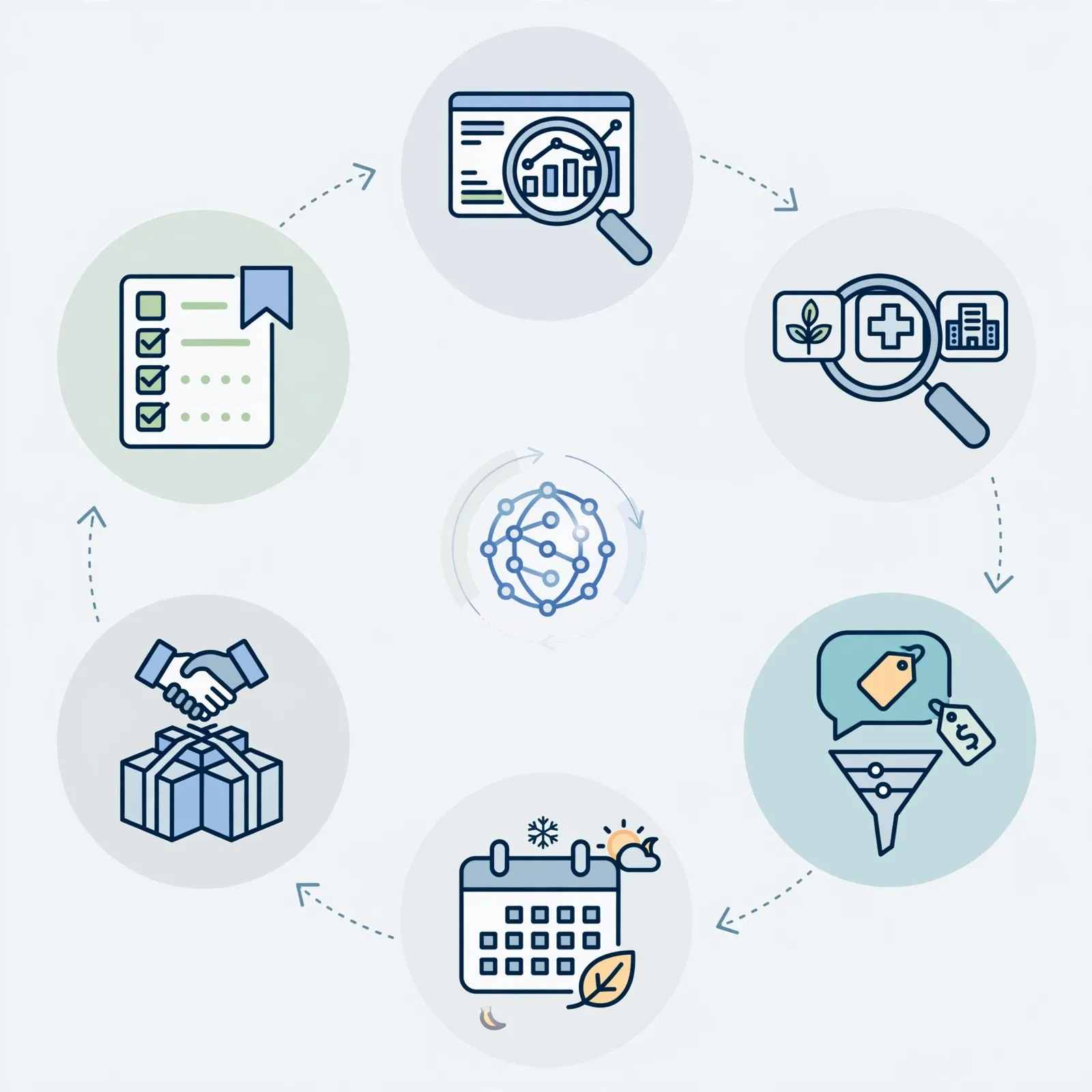
Finding a fair-priced premium domain comes down to process, not luck. Here’s a practical sequence to follow:
Start with appraisal data, not asking price.
Before evaluating any listing, check what comparable domains have sold for recently.
Search underpriced niches.
Categories like agri-tech, medical services, and B2B software are often less competitive than generic e-commerce or crypto niches, so pricing tends to be lower.
Filter by “make offer” listings.
Sellers open to offers are usually more flexible than those with fixed BIN (Buy It Now) pricing.
Buy during off-peak seasons.
Domain demand often dips in late summer and just after the new year, which can soften pricing.
Bundle negotiations.
If a seller owns multiple relevant domains, ask about a bundle discount instead of buying one at a time.
Each of these strategies works best in combination rather than isolation. A buyer who checks appraisal data but skips the “make offer” filter, for example, may still end up paying close to full asking price simply because they never opened a negotiation. Likewise, timing a purchase for a slower season won’t help much if the underlying domain is genuinely scarce and in high demand year-round. The goal is to stack as many of these advantages together as possible – accurate valuation, a flexible seller, favorable timing, and a bundle opportunity where available – since each one compounds the potential savings.
Each of these strategies works best in combination rather than isolation. A buyer who checks appraisal data but skips the “make offer” filter, for example, may still end up paying close to full asking price simply because they never opened a negotiation. Likewise, timing a purchase for a slower season won’t help much if the underlying domain is genuinely scarce and in high demand year-round. The goal is to stack as many of these advantages together as possible – accurate valuation, a flexible seller, favorable timing, and a bundle opportunity where available – since each one compounds the potential savings.
It’s also worth tracking a shortlist of five to ten target domains rather than fixating on a single name. Spreading your search across multiple options gives you leverage in negotiations (you’re not desperate for any one specific listing) and increases the odds that at least one seller is motivated enough to accept a below-asking offer.
For a more detailed walkthrough of the buying process itself, see our guide on how to secure a premium domain without overpaying.
Comparison Table: Where to Buy Premium Domains
| Buying Channel | Typical Price Range | Speed | Negotiation Room | Best For |
|---|---|---|---|---|
| Registrar (unregistered) | $10–$50/year | Instant | None | New, unclaimed brandables |
| Curated aftermarket marketplace | $100–$5,000 | 1–3 days | Moderate–High | Buyers wanting vetted, fair-priced listings |
| Domain auctions | $200–$10,000+ | Days (bidding window) | Low (competitive bidding) | Buyers chasing specific expiring names |
| Private broker | $1,000–$50,000+ | Weeks | High, but with added commission | High-value or hand-registered targets |
Quick Comparison: Marketplace vs. Auction
| Factor | Marketplace Purchase | Auction Purchase |
|---|---|---|
| Price predictability | High – fixed or offer-based | Low – driven by competing bids |
| Risk of overpaying | Lower | Higher, especially in bidding wars |
| Time investment | Low | Moderate to high |
| Ideal buyer | Budget-conscious founders | Investors chasing a specific asset |
How Domain Appraisal Tools Help You Avoid Overpaying
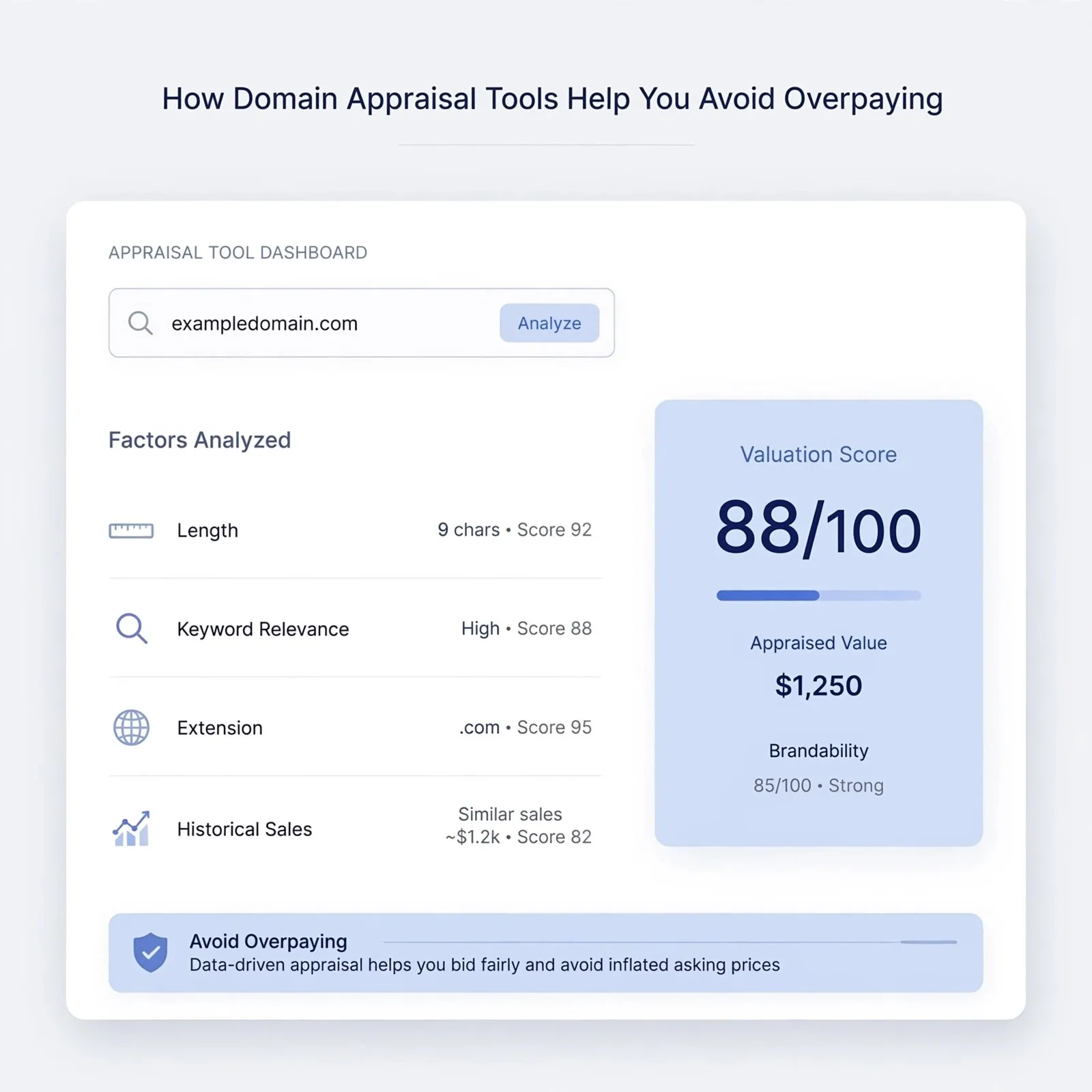
Appraisal tools estimate a domain’s fair market value using length, keyword relevance, extension, and historical sales data. Relying on these tools before making an offer is one of the simplest ways to keep your budget in check.
Our article on how appraisal tools calculate premium domain value explains the exact factors that influence a valuation score, so you can spot an overpriced listing at a glance.
Quick answer: A fair domain price generally falls close to its appraised value, adjusted slightly upward for exceptional brandability or downward for a less common extension.
Common Mistakes to Avoid When Buying Premium Domains Cheap
Even experienced buyers overpay when they skip due diligence. Watch out for these recurring mistakes:
- Anchoring to the seller’s asking price instead of researching comparable sales first.
- Ignoring extension value. A .net or .co version of a great .com name is not equivalent in resale or brand value.
- Skipping escrow. Wiring funds directly to a seller without an escrow service is a common cause of domain scams.
- Rushing during auctions. Bidding wars frequently push final prices well above fair market value.
- Overlooking trademark conflicts. A cheap domain isn’t a bargain if it triggers a legal dispute down the line.
- Chasing “perfect” instead of “good enough.” Holding out for an ideal one-word .com often means paying a premium that a slightly longer, still-brandable alternative would have avoided entirely.
- Not budgeting for renewal costs. Some premium extensions carry higher annual renewal fees than the initial purchase price suggests, which changes the real cost of ownership over several years.
- Negotiating without a walk-away price. Buyers who don’t set an upper limit before entering negotiations are more likely to get pulled above fair market value by seller framing or artificial urgency.
Each of these mistakes shares a common thread: they all come from moving too quickly. Slowing down to verify data, extension costs, and legal standing before committing funds is consistently the difference between a fair deal and an inflated one.
Expert Tips for Negotiating a Better Price
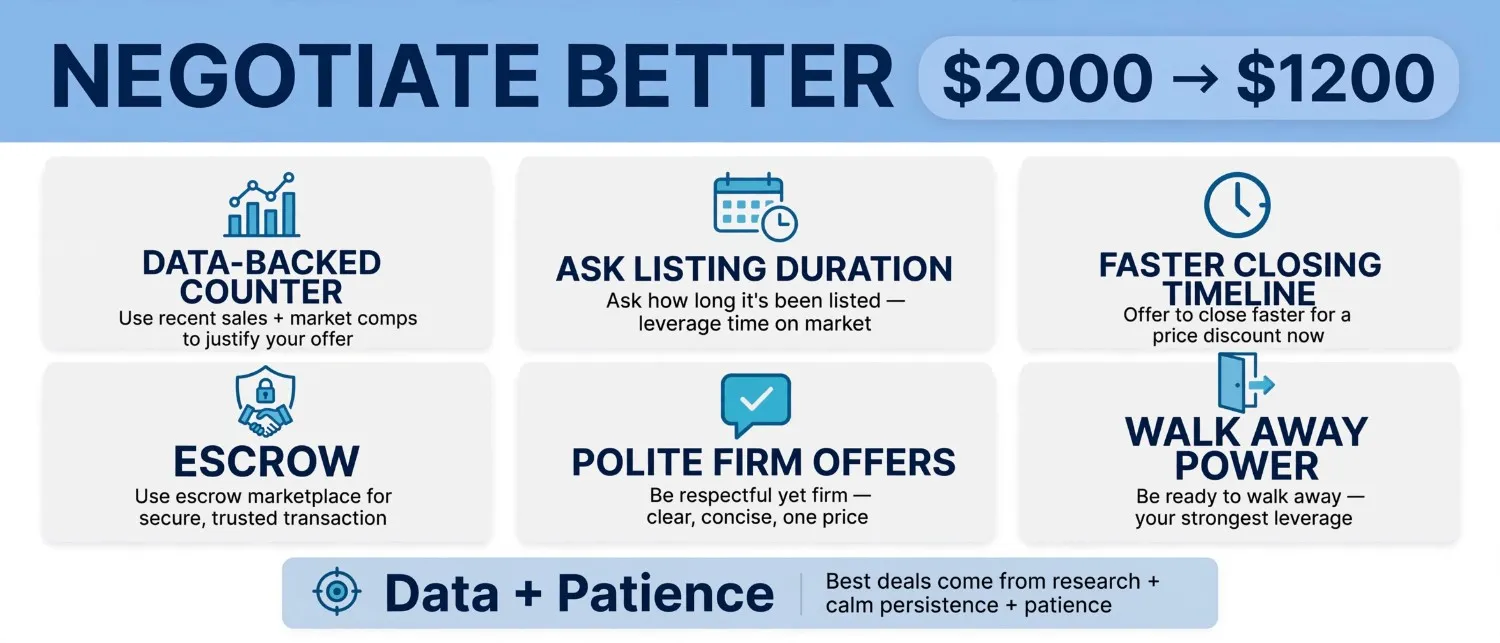
Negotiation is where most of the savings actually happen. A domain listed at $2,000 might close at $1,200 simply because the buyer approached the conversation with data and patience rather than urgency.
- Always counter with a data-backed number, referencing appraisal estimates or recent comparable sales.
- Ask sellers how long the domain has been listed – names sitting unsold for months are often more negotiable.
- Offer a faster closing timeline in exchange for a lower price; many sellers value speed over maximum value.
- Buy through a marketplace that has escrow built into the transaction flow, since this reduces friction (and cost) compared to arranging third-party escrow yourself.
- Keep initial offers polite but firm – lowballing aggressively can end a conversation before it starts, while a reasonable, well-justified offer keeps the seller engaged.
- Be prepared to walk away. Sellers who sense genuine willingness to pass on a deal are often more flexible on price than those negotiating with a buyer who seems committed no matter what.
A Practical Negotiation Example
Consider a buyer interested in a six-character, dictionary-word .com listed at $3,500. Appraisal data pulled from three comparable recent sales shows similar names closing between $1,800 and $2,400. Rather than accepting the asking price or making a token counteroffer, the buyer opens at $1,900, references the comparable sales directly, and offers a 48-hour close through escrow. The seller, who had been trying to sell the domain for several months, counters at $2,300. The final sale closes at $2,100 – roughly 40% below the original asking price, and squarely within fair market range. This is the pattern that consistently works: data first, patience second, and a credible closing timeline third.
Premium Domains for Startups on a Tight Budget
Startups often assume a strong domain is out of reach financially in the early stages. In reality, plenty of brandable, short names are available well under $1,000 if you know where to look and are flexible on category. Our guide to affordable domain options built for early-stage branding covers specific strategies for stretching a limited domain budget without settling for a weak brand name.
Domain Investing for Beginners: A Related Angle
If you’re buying with resale potential in mind rather than purely for branding, it helps to understand basic domain investing principles – things like renewal cost management, extension selection, and timing your resale. Our beginner’s introduction to low-cost domain investing is a useful next read if this applies to you.
The Current State of the Premium Domain Market
Domain pricing doesn’t exist in a vacuum – it moves with broader registration trends. According to Verisign’s quarterly Domain Name Industry Brief, the total number of registered domain names across all top-level extensions has continued to grow year over year, which means the pool of genuinely available, high-quality short names keeps shrinking. This steady growth is exactly why the aftermarket has become the dominant channel for acquiring anything resembling a premium name: registrar-level availability for strong .com combinations has simply not kept pace with demand.
For buyers, this trend has two practical implications:
Waiting rarely helps.
Unlike some markets where prices soften with delay, quality domain inventory tends to tighten over time, not loosen.
Flexibility on category or extension pays off.
Buyers willing to consider adjacent niches, slightly longer names, or a secondary extension typically pay meaningfully less than those fixated on one exact combination.

Who Should Buy on the Aftermarket vs. Wait for a New Registration
Not every buyer has the same priorities, and the “best” buying channel depends on what you’re optimizing for.
Founders launching soon
Aftermarket purchases make sense, since waiting for an ideal unregistered name to appear can delay a launch indefinitely.
Long-term domain investors
A mix of both approaches often works best – hand-registering low-cost speculative names while selectively buying proven aftermarket assets.
Rebranding businesses
Aftermarket purchases are almost always the practical route, since a rebrand typically needs a specific, already-taken name rather than a flexible new one.
Budget-constrained startups
A hybrid approach works well here too – hand-register a backup option while negotiating on a stronger aftermarket target, so the business isn’t left without a domain if negotiations stall.
Step-by-Step: How to Buy a Premium Domain the Smart Way
- Define your criteria. Length, keyword relevance, and extension priority.
- Check appraisal value for any domain you’re seriously considering.
- Verify ownership and transfer history through a WHOIS lookup.
- Make a data-backed offer, referencing comparable sales.
- Use an escrow-protected transaction to finalize payment and transfer.
- Update DNS and registrar details once transfer confirmation is complete.
According to ICANN’s registrant guidance, verifying WHOIS and transfer authorization codes is a standard safeguard before any ownership transfer completes. Using a transaction process backed by escrow protection is also widely recommended across the domain industry to prevent payment fraud during a private-party sale.
How to Budget for a Premium Domain Purchase
Setting a realistic budget before you start browsing prevents both overspending and the frustration of falling in love with a name you can’t afford. A simple framework:
- Set a hard ceiling. Decide the maximum you’re willing to spend before you view a single listing, and treat it as non-negotiable.
- Reserve 10-15% for negotiation flexibility. If your true ceiling is $2,000, start your search closer to $1,700-$1,800 so you have room to move up during negotiation without exceeding your limit.
- Factor in renewal costs separately. Multiply the annual renewal fee by at least three years to understand the real multi-year cost of ownership, not just the upfront price.
- Account for escrow and transfer fees. These are typically small (often under $100 or a small percentage of the sale price) but should still be included in your total budget.
- Leave room for a backup option. If your top choice falls through during negotiation, having a secondary name in mind prevents rushed decisions later.
This kind of structured budgeting is often what separates buyers who consistently find the best place to buy premium domains cheap from those who end up overpaying out of urgency.
How to Vet a Domain Seller Before You Commit
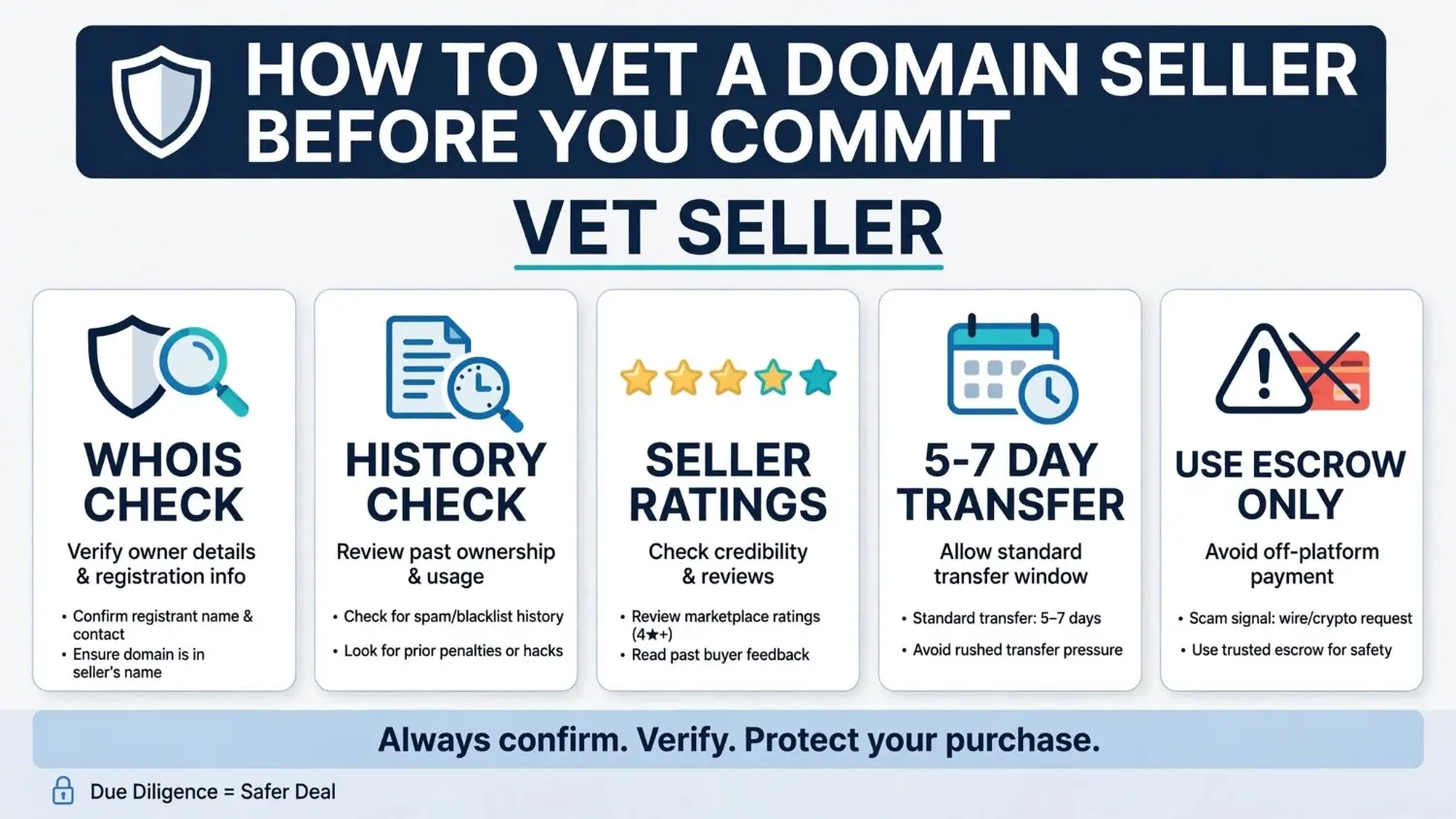
Even on reputable marketplaces, a small amount of due diligence goes a long way toward avoiding disputes after the sale.
- Confirm registrar-level ownership. A WHOIS lookup should show the seller (or their listed agent) as the current registrant.
- Check the domain’s history. Tools that show past ownership changes or expiration events can flag potential red flags, such as a domain that was previously used for spam.
- Review marketplace seller ratings, where available, for a track record of completed, dispute-free transactions.
- Ask direct questions about transfer timing. A legitimate seller will typically confirm they can initiate a transfer within a standard 5-7 day window once payment clears escrow.
- Avoid sellers who push for payment outside the marketplace’s built-in system. This is one of the most common signals of an attempted scam in private domain sales.
Taking these steps rarely adds more than a day to the process, but it meaningfully reduces the risk of a failed or disputed transaction – which, in the long run, is far more costly than the domain itself.
Frequently Asked Questions
What is the best place to buy premium domains cheap?
A curated aftermarket marketplace with transparent appraisal data and escrow-backed transfers is generally the best place to buy premium domains cheap, since it removes broker commissions and lets you compare pricing directly against comparable sales.
Are premium domains ever available at registrar prices?
Occasionally, yes – if a strong brandable name happens to be unregistered, you can secure it for standard registration fees. This is rare for competitive niches but more common in specialized industries.
How much should I expect to pay for a decent premium domain?
Many quality brandable domains sell in the $200-$2,000 range, well below the five- and six-figure prices associated with ultra-premium generic terms.
Is it safe to buy a premium domain directly from a private seller?
It can be, provided the transaction goes through an escrow service. Direct wire transfers without escrow protection carry a meaningful fraud risk.
Do domain extensions other than .com count as premium?
They can, especially for regional or industry-specific brands, but .com generally commands the highest resale and brand-recognition value.
How long does it typically take to close a cheap premium domain deal?
Most aftermarket purchases close within one to three business days once an offer is accepted, assuming the transaction runs through an escrow service. Auctions can take longer due to fixed bidding windows, while broker-negotiated deals often take several weeks.
Can I negotiate the price on a “Buy It Now” listing?
Often, yes. Many marketplaces allow buyers to submit a lower offer even on fixed-price listings, and sellers frequently accept a reasonable counteroffer rather than let a listing sit unsold.
Key Takeaways Before You Buy
If you remember nothing else from this guide, keep these five points in mind:
- The aftermarket, not the registrar, is realistically the best place to buy premium domains cheap for most buyers today, since strong unregistered .com names are increasingly rare.
- Appraisal data should always come before an offer, not after – it’s the single best defense against overpaying.
- Escrow-protected transactions are non-negotiable for private-party sales; skipping this step is where most domain buying scams originate.
- Negotiation, patience, and a credible closing timeline routinely save 20-40% off an initial asking price.
- A clear budget – including renewal costs and transfer fees – keeps the entire process focused and prevents impulse overspending on a name that isn’t actually worth its asking price.
Final Thoughts

Finding the best place to buy premium domains cheap comes down to using the right channel, verifying value with appraisal data, and protecting the transaction with escrow. None of these steps require special expertise – they simply require slowing down enough to check the data before committing funds. Buyers who follow this process consistently end up with strong, brand-ready domains at a fraction of what impulsive or under-researched buyers pay for comparable names. Skip the guesswork and to find your next domain today.
Browse Vetted, Fairly Priced Premium Domains built for Real Brands →