
A premium domain name is a short, brandable, or keyword-rich web address that carries higher commercial value than a standard registration because of its memorability, search intent, or existing brand equity. Unlike a freshly registered domain that costs a few dollars a year, a premium domain is priced based on demand, not registration cost. If you have ever wondered what is a premium domain name and why some addresses sell for thousands while others cost next to nothing, this guide breaks it down with real examples, valuation logic, and buying tips.
For founders who want the branding power of a premium name without the five-figure price tag, exploring affordable premium domain inventory is often the smarter starting point than chasing ultra-generic one-word domains.
What is a Premium Domain Name, Really?
At its core, a premium domain name is any web address that a registry or private seller has flagged as more valuable than a typical new registration. Instead of the standard $10-$20 annual fee, these names carry a one-time premium price, or they are already owned and listed for resale on the secondary market.
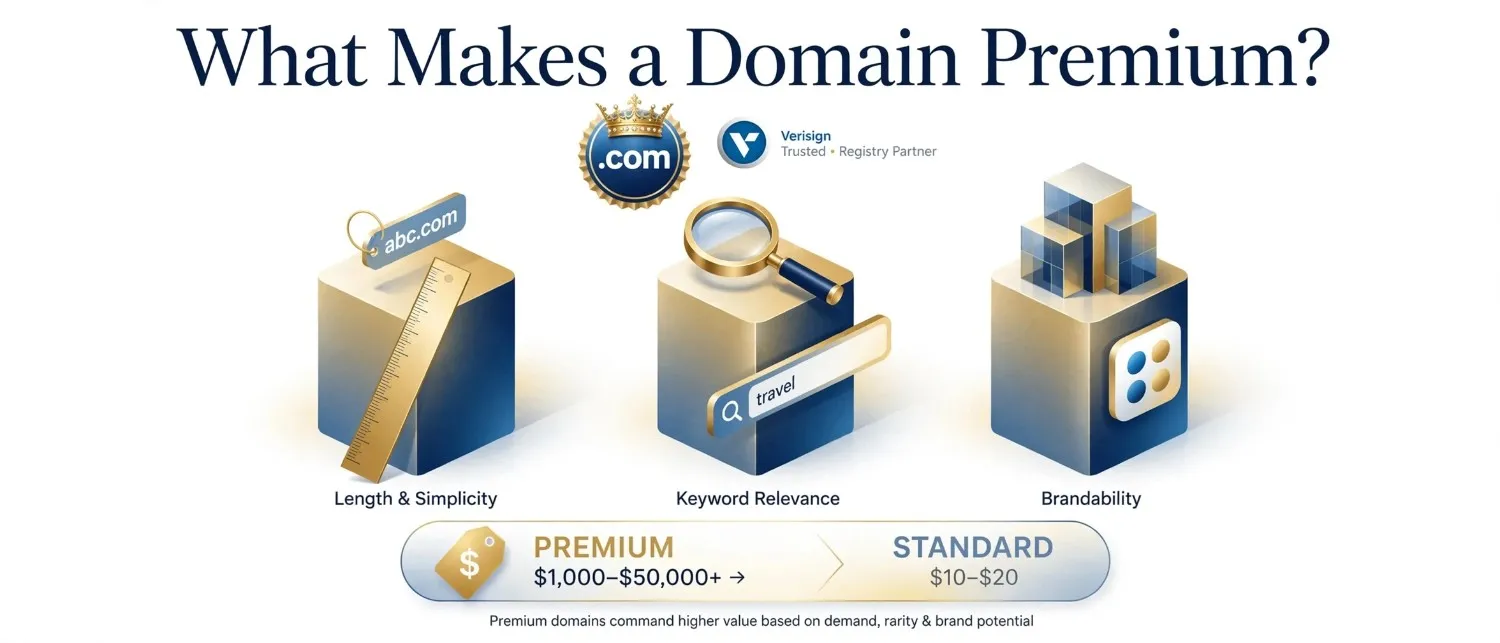
Three factors usually push a domain into “premium” territory:
- Length and simplicity – shorter names are easier to remember and type.
- Keyword relevance – names that match high-intent search terms attract organic traffic.
- Brandability – names that sound like a real company, product, or app.
Domain registries such as Verisign, which manages the .com and .net registries, also maintain internal lists of premium names that were never released at standard pricing because of their perceived commercial value. According to Verisign’s own domain industry reporting, .com remains the most sought-after extension globally, which is part of why premium .com names hold their price so well over time.
A Brief History of How Premium Domains Became a Market
Domain names were never designed to be assets. When the .com registry opened to the public in the early 1990s, names were handed out on a first-come, first-served basis for a nominal annual fee. Early registrants, some of them speculators and some simply early internet adopters, picked up single-word and short generic terms without any idea of what those names would later be worth.
By the early 2000s, as e-commerce matured and businesses realized a memorable web address translated directly into customer trust, a genuine resale market emerged. Domain brokers, auction houses, and appraisal services formed around this demand, and terms like “premium domain” entered common industry vocabulary to distinguish these high-value names from ordinary new registrations.
Today, the premium domain market operates similarly to other scarce digital or physical assets. Prices are driven by comparable sales, expert appraisal, and genuine buyer demand rather than any fixed formula, which is part of why the same domain can receive wildly different offers depending on who is asking and what they plan to build.
Key Characteristics of a Premium Domain Name
Not every short domain qualifies as premium, and not every expensive domain is actually worth the price. Here are the traits that consistently separate genuine premium names from overpriced listings:
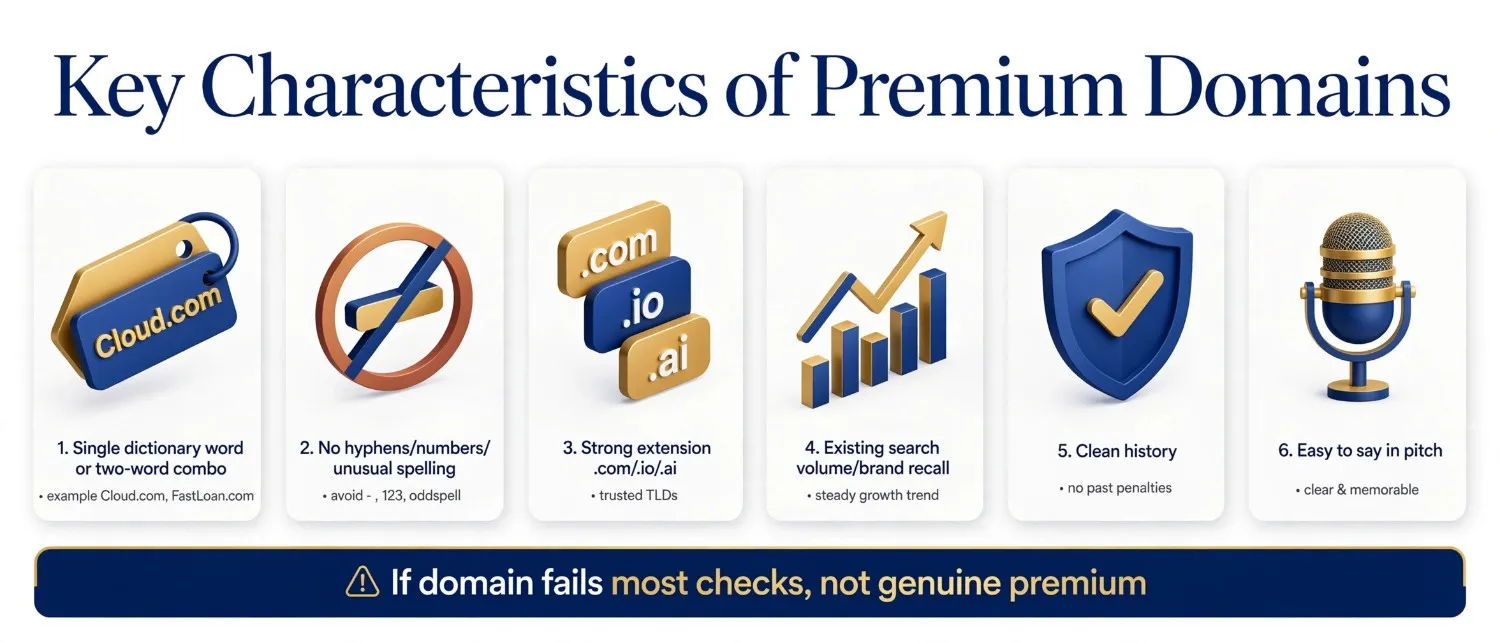
- Single dictionary word or two-word combination (e.g., Cloud.com, FastLoan.com)
- No hyphens, numbers, or unusual spelling
- Strong extension, typically .com, though .io and .ai have gained premium status in tech niches
- Existing search volume or brand recall tied to the keyword
- Clean history – no prior spam, penalties, or trademark disputes
- Easy to say over the phone or in a pitch meeting
If a domain fails most of these checks, it is likely being marketed as premium without the fundamentals to justify the price. This is one of the most common traps first-time buyers fall into, and it is covered in more depth in this guide to buying a premium domain without overpaying.
Examples of Premium Domain Names
To make the definition concrete, here is how premium domains typically break down by category:
| Category | Example Style | Why It’s Premium |
|---|---|---|
| Single word .com | Fitness.com, Loans.com | High search demand, instant recall |
| Brandable invented word | Aolra, Zapier, Canva | Short, unique, trademarkable |
| Two-word keyword match | HomeLoans.com, CloudBackup.com | Matches buyer search intent directly |
| Industry-specific | RealEstateAI.com, LegalDocs.com | Niche authority + SEO value |
| Geo + keyword | AustinLawyers.com, NYCRealty.com | Local search targeting |
Some of these categories cost six or seven figures at auction. Others, particularly newer brandable and two-word keyword combinations, are available at a fraction of that cost because demand has not yet peaked. This gap is exactly why domain investing beginners are advised to focus on emerging categories rather than saturated one-word .com names, a strategy explained further in this beginner’s approach to low-cost premium names.
Premium Domain vs Regular Domain: A Side-by-Side Comparison
| Feature | Regular Domain | Premium Domain |
|---|---|---|
| Price | $8–$20/year | $200–$500,000+ (one-time or resale) |
| Availability | Instantly registrable | Often already owned or registry-reserved |
| Branding value | Neutral | High, often self-explanatory |
| SEO advantage | None inherent | Keyword or authority signal |
| Resale potential | Low | Moderate to high |
| Typical buyer | New blogs, small local sites | Startups, funded companies, investors |
The pricing gap looks intimidating at first glance, but it is worth noting that “premium” is a spectrum, not a fixed tier. A domain priced at $300 with strong branding can outperform a $30,000 name that is harder to say or spell.
How Premium Domain Names Are Valued
Domain appraisal is part art, part data. Professional appraisers and automated tools typically weigh:
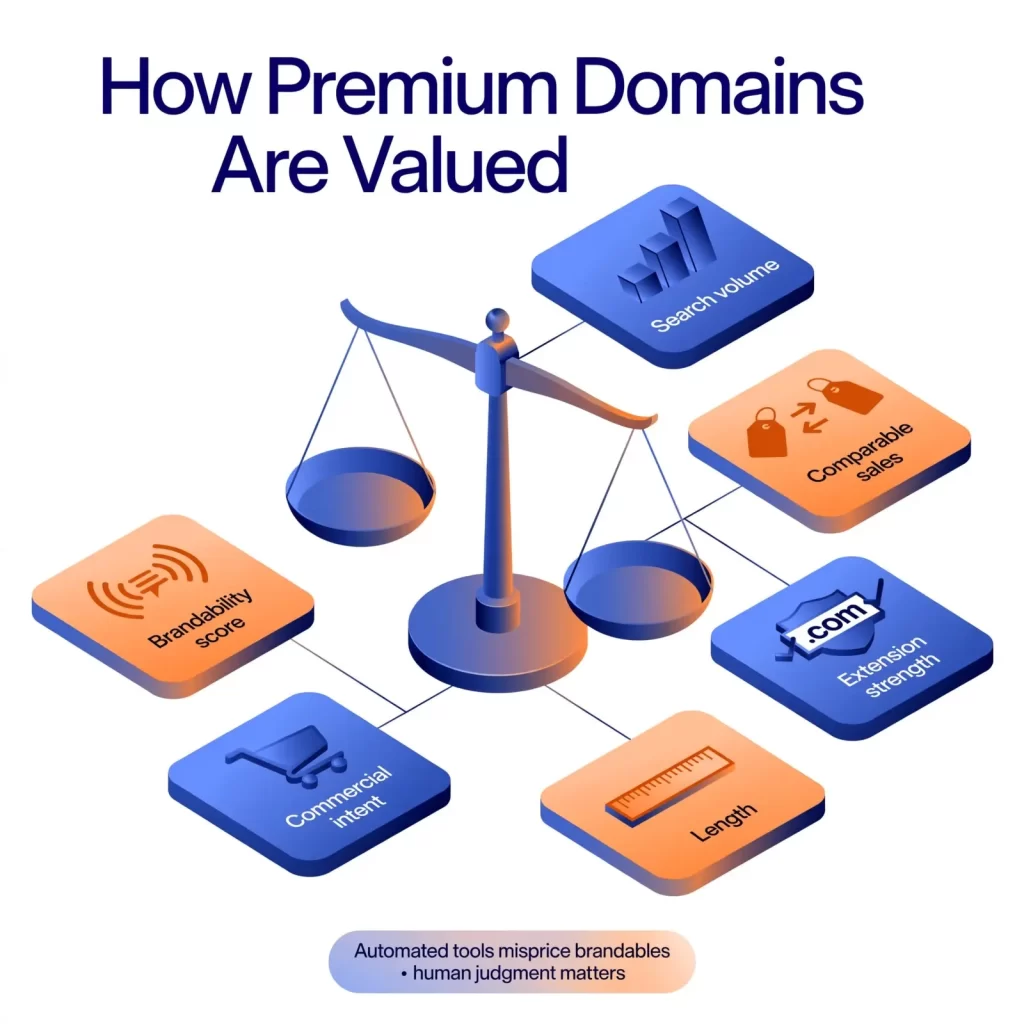
- Search volume for the exact keyword phrase
- Comparable sales of similar names in the last 12–24 months
- Extension strength, with .com generally outperforming newer TLDs
- Length, since shorter names almost always command higher prices
- Commercial intent, meaning whether the term is tied to buying behavior
- Brandability score, a more subjective factor based on pronunciation and memorability
Automated appraisal tools can give a fast estimate, but they frequently misprice brandable names because algorithms struggle to judge “sound” and emotional appeal the way a human buyer does. A full walkthrough of how these valuation models work, and where they fall short, is available in this breakdown of how appraisal tools calculate premium domain value.
The Psychology Behind Why Certain Domain Names Feel “Premium”
Beyond raw data, there is a psychological layer to why some names simply feel more valuable than others. Human brains process short, rhythmic words faster than long or awkward ones, which is why names like Uber, Canva, or Zapier stick instantly while clunky, hyphenated alternatives fade from memory within seconds.
A few psychological principles consistently show up in strong premium names:
Phonetic Simplicity
The name uses common sounds that exist across multiple languages, making it easier to say for a global audience.
Positive association
The word or invented term carries a subtly positive or neutral connotation rather than an awkward or negative one.
Pattern familiarity
The name follows a structure the brain already recognizes as “brand-like,” similar to existing successful companies.
Distinctiveness
It stands apart enough from competitors to avoid confusion, while still feeling intuitive.
This is precisely why appraisal tools that rely purely on keyword volume and length often undervalue strong brandable names. A human buyer’s gut reaction to how a name sounds in a sentence can carry as much weight as any numerical score.
Why Do Premium Domains Cost More Than Regular Ones?
The price difference comes down to scarcity and opportunity cost, not the registration mechanics. A handful of reasons explain the markup:
- Finite supply – there are only so many short, clean words in any language.
- First-mover advantage – early buyers registered generic terms decades ago for almost nothing, then resold them at a markup.
- Marketing savings – a strong domain reduces the advertising spend needed to build brand recognition.
- SEO head start – keyword-matched domains historically attracted more organic clicks, even though Google has reduced this weighting over the years.
- Investor speculation – domain investors treat premium names similarly to digital real estate, holding them until demand rises.
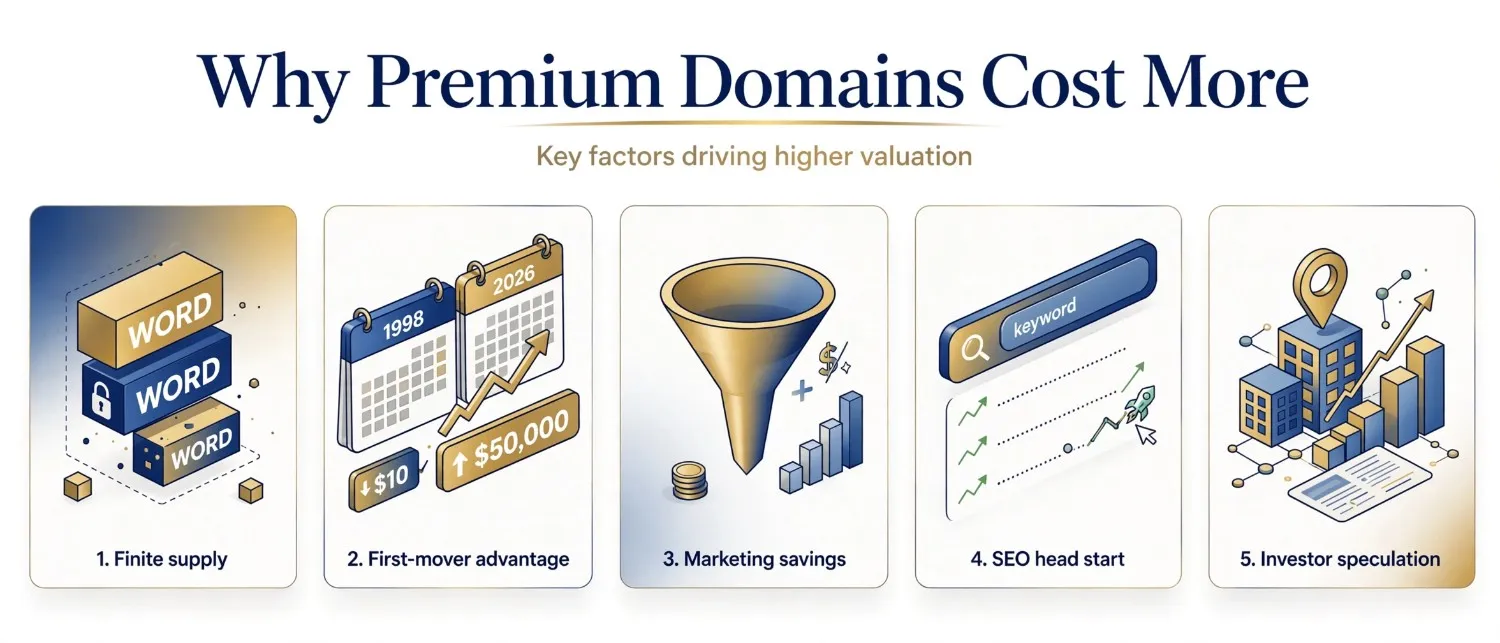
Because of these dynamics, premium domain pricing does not always track neatly with cost-to-produce. A name someone registered for $10 in 1998 can legitimately sell for $50,000 today if the underlying keyword became commercially valuable.
Common Mistakes Buyers Make With Premium Domain Names
Even experienced founders misjudge premium domain purchases. The most frequent errors include:
- Overpaying for a “prestige” one-word domain without checking real comparable sales data.
- Ignoring trademark conflicts, which can trigger legal disputes after purchase; the World Intellectual Property Organization handles thousands of domain-related disputes annually, so trademark screening before purchase is not optional.
- Choosing a hard-to-spell brandable name purely because it “sounded premium” in a pitch.
- Skipping escrow services during private sales, exposing the buyer to fraud risk.
- Confusing high price with high value, when the metric that matters is actual business impact, not the invoice.
- Buying an extension mismatch, such as pairing a serious B2B service with a playful .fun or .xyz extension.
Avoiding these pitfalls usually comes down to slowing down the decision and running the name through a checklist rather than reacting emotionally to a big number on a marketplace listing.
Expert Tips for Choosing the Right Premium Domain
Industry professionals who buy and sell domains for a living tend to follow a consistent set of rules:
- Say it out loud – if a stranger cannot spell it after hearing it once, reconsider.
- Check trademark databases before finalizing any purchase.
- Compare at least three recent sales in the same category before negotiating price.
- Prioritize .com unless the audience is exclusively tech or startup-focused, where .io and .ai are increasingly accepted.
- Budget for total cost, including any broker fees, escrow charges, and transfer costs.
- Think five years ahead – a domain should still make sense as the business scales, not just at launch.
Founders on a tighter budget often find that a well-chosen, moderately priced brandable name outperforms an expensive generic one, particularly when paired with consistent content and marketing. Reviewing affordable options built specifically for startup branding is a practical next step before committing to a five-figure purchase.
Quick Answer Box: Premium Domain Name in One Sentence
A premium domain name is a short, memorable, or keyword-rich web address priced above standard registration cost because of its proven or projected commercial value.
Step-by-Step: How to Evaluate a Premium Domain Before Buying
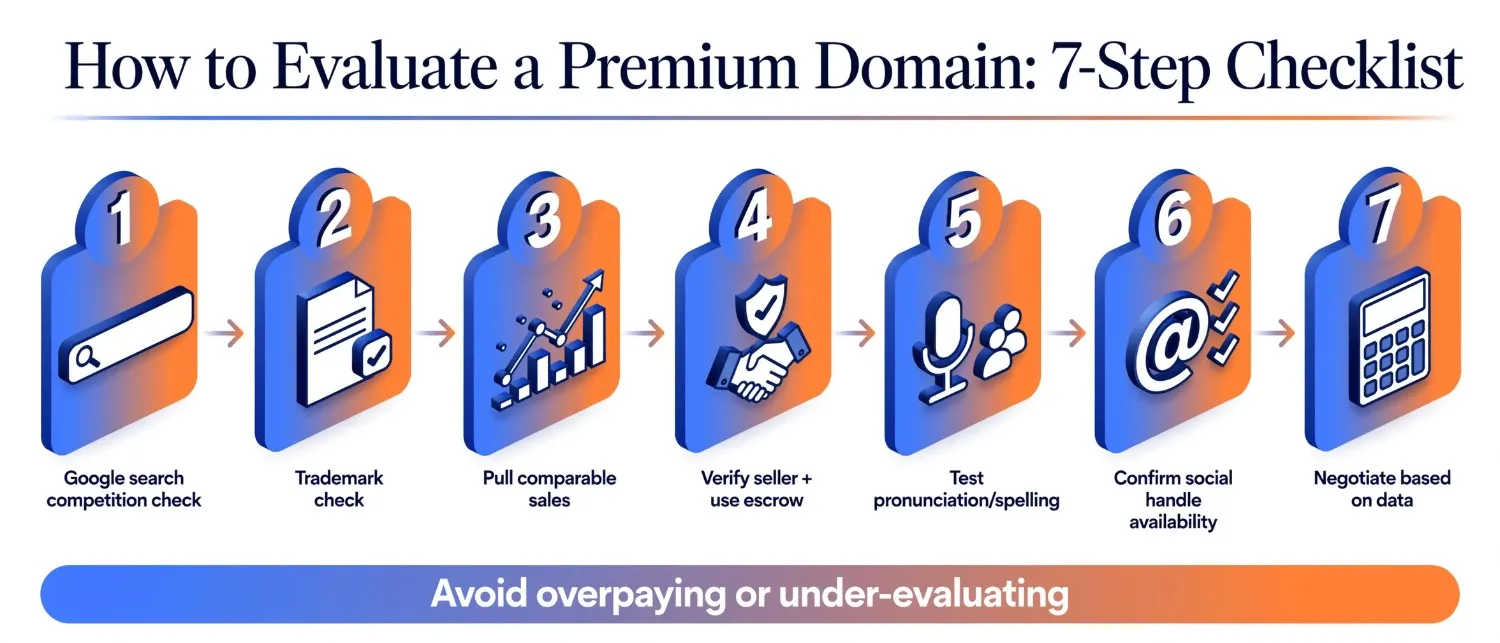
- Search the exact term in Google to check existing competition and intent.
- Run a trademark check through official IP databases.
- Pull comparable sales from domain marketplaces or appraisal history.
- Verify the seller and use escrow for any transaction above a few hundred dollars.
- Test pronunciation and spelling with a few people outside the industry.
- Confirm extension availability across social handles to keep branding consistent.
- Negotiate based on data, not the seller’s asking price alone.
Following this sequence removes most of the guesswork and protects buyers from the two most common outcomes in domain purchasing: overpaying, or under-evaluating a name that later needs an expensive rebrand.
Common Myths About Premium Domain Names
Misinformation spreads quickly in the domain industry, partly because pricing feels opaque to newcomers. A few myths deserve to be corrected:
Premium always means one word
In reality, two-word combinations and short brandable inventions make up a growing share of the premium market, especially as one-word .com names have become nearly impossible to acquire at reasonable prices.
A higher price always means better SEO
Search engines do not reward a domain simply for containing a keyword; relevance, content quality, and backlinks matter far more today than they did a decade ago.
Only .com domains can be premium
While .com remains the strongest default, .io, .ai, and .co have carved out legitimate premium status within specific industries, particularly technology and software.
Premium domains are only for big companies
Plenty of premium-tier names are priced in the low hundreds, making them accessible to solo founders and small teams, not just funded startups.
Once listed as premium, the price never changes
Prices shift based on market demand, comparable sales, and even how long a name sits unsold, so negotiation is almost always possible.
How to Negotiate the Price of a Premium Domain
Negotiation is expected in this market, and most listed prices carry some room to move. A structured approach tends to work better than an emotional one:
- Open with data, referencing at least two or three comparable sales rather than simply offering a lower number.
- Ask about payment flexibility, since some sellers accept installment plans for higher-priced names.
- Clarify what’s included, such as whether social media handles or existing backlinks transfer with the domain.
- Use a neutral third-party escrow service to build trust and speed up the transaction once a price is agreed.
- Be patient, since sellers who feel rushed rarely offer their best price, while those given time to consider a fair, data-backed offer often come back with a counter closer to the buyer’s target.
Who Actually Buys Premium Domain Names?
The premium domain market is not limited to large corporations with unlimited budgets. In practice, buyers tend to fall into a few distinct groups, each with different priorities:
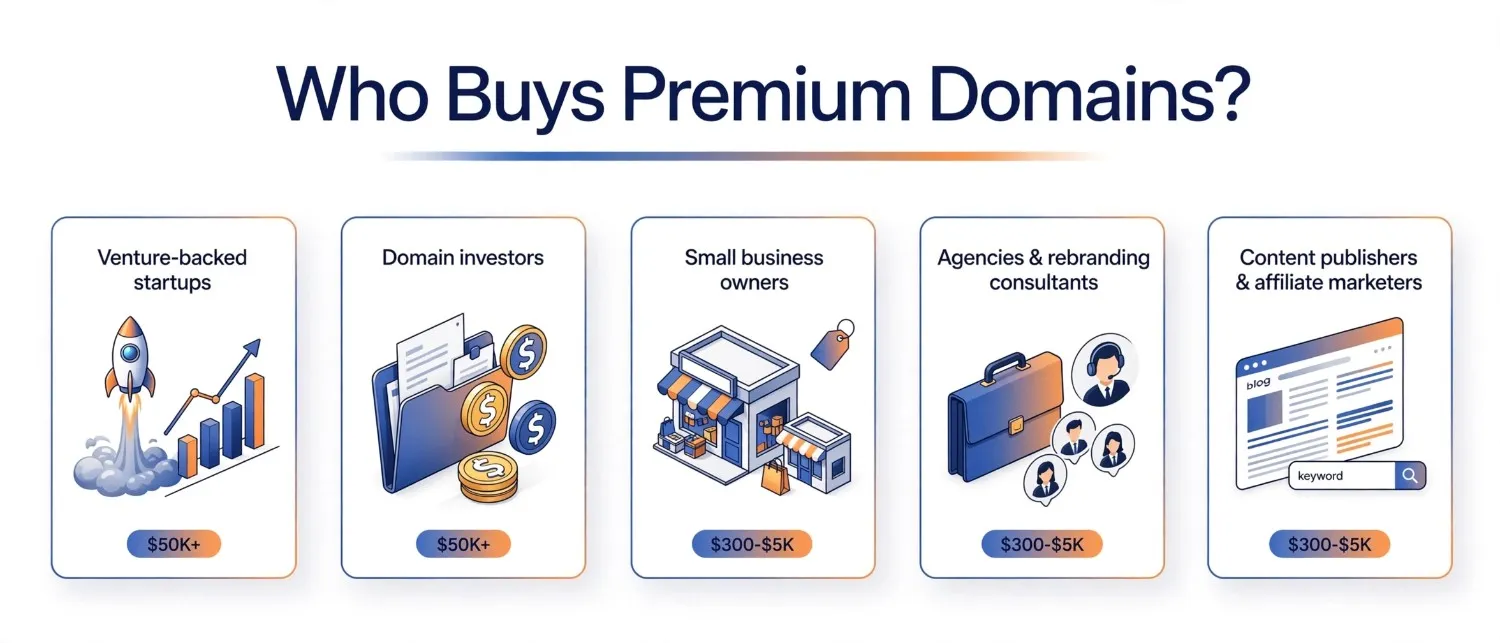
- Venture-backed startups – often willing to pay a premium early because a strong domain supports fundraising credibility and reduces future rebranding costs.
- Domain investors – purchase names purely as speculative assets, holding them until a matching business or brand emerges and drives up demand.
- Small business owners – typically prioritize affordability and clarity over prestige, favoring a clean, moderately priced brandable name over an expensive generic one.
- Agencies and rebranding consultants – acquire domains on behalf of clients going through a name change, often working within a fixed budget set by the client.
- Content publishers and affiliate marketers – look for keyword-matched domains that can support niche authority sites, even though the direct SEO benefit has diminished over time.
Understanding which category a buyer falls into is useful before shopping, since it shapes whether a $50,000 one-word .com or a $300 brandable alternative actually makes more sense for the goal at hand.
Premium Domains and Long-Term Brand Equity
A domain is rarely just a technical address; it becomes shorthand for the entire brand experience over time. This is why companies that started with a keyword-heavy domain sometimes later invest heavily to acquire a shorter, brandable alternative once they have the budget to do so.
Consider the pattern many growing companies follow:
- Launch with an affordable, available domain that fits the budget.
- Build product traction, customer trust, and search visibility over one to three years.
- Once revenue supports it, acquire a shorter or more brandable premium name to match the company’s growth stage.
- Redirect the original domain to preserve existing SEO equity and avoid losing organic traffic.
This staged approach means a premium domain purchase does not have to happen on day one. Plenty of successful companies operated for years on a modest domain before eventually investing in a stronger one once the business justified the cost.
Industry Outlook: Are Premium Domains Still Worth
Some commentators have questioned whether domain names still matter as much in an era of app stores, social media handles, and AI-driven search interfaces. The honest answer is nuanced.
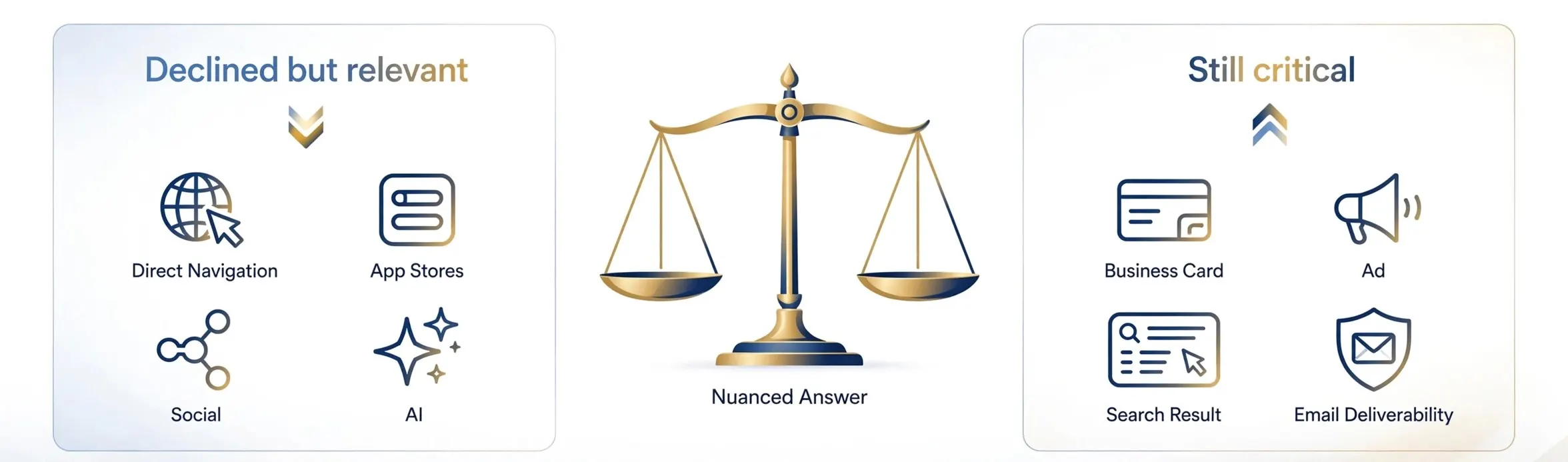
Direct navigation, where users type a domain straight into the browser, has declined somewhat as search and social discovery dominate how people find businesses. However, a strong domain still functions as a trust signal the moment a potential customer sees it in an ad, a business card, or a search result. It also remains a foundational part of email deliverability, since a clean, established domain typically performs better than a newly registered or unusual one.
For most founders, the practical takeaway is that a premium domain is still a worthwhile investment, provided the price paid matches the actual business stage and budget, rather than chasing prestige for its own sake.
Frequently Asked Questions
What is a premium domain name in simple terms?
It is a web address considered more valuable than a standard registration, usually because it is short, keyword-rich, or highly brandable, and is priced accordingly by registries or resellers rather than at a flat annual rate. The core distinction is that ownership of a premium name is treated more like acquiring an asset than simply registering an available string of text.
Why are premium domain names so expensive?
Prices reflect scarcity of short, clean words, existing search demand, and the marketing value a strong name provides, not the actual cost of registering the domain. A registrar’s technical cost to issue any domain is nearly identical whether it sells for $12 or $120,000; the difference in price comes entirely from perceived and demonstrated market value.
Is a premium domain worth it for a small business?
It can be, especially if the name reduces long-term marketing costs and builds instant trust, but small businesses often benefit more from an affordable, brandable premium name than an expensive one-word generic domain. The right choice usually depends on current budget stage rather than an assumption that the most expensive available option is automatically the best fit.
How do I know if a domain is genuinely premium or overpriced?
Compare it against recent sales of similar names, check search volume for the keyword, and evaluate how easily it can be spoken and spelled aloud without needing repeated clarification. If a seller cannot point to any comparable sales data to justify the asking price, that alone is often a sign the listing is overpriced relative to the current market.
Can a premium domain improve SEO rankings directly?
Not directly in modern algorithms, but a clear, keyword-relevant, or brandable domain can improve click-through rates and user trust, which indirectly supports SEO performance over time. Google has publicly moved away from rewarding exact-match keyword domains on their own, placing far more weight on content quality, backlinks, and overall site experience.
Where can I buy affordable premium domain names?
Marketplaces that specialize in curated, moderately priced brandable and keyword domains are usually a better starting point than high-end auction platforms for buyers on a limited budget. These platforms typically pre-screen names for trademark conflicts and spelling clarity, which removes much of the manual due diligence a buyer would otherwise need to handle alone.
Conclusion
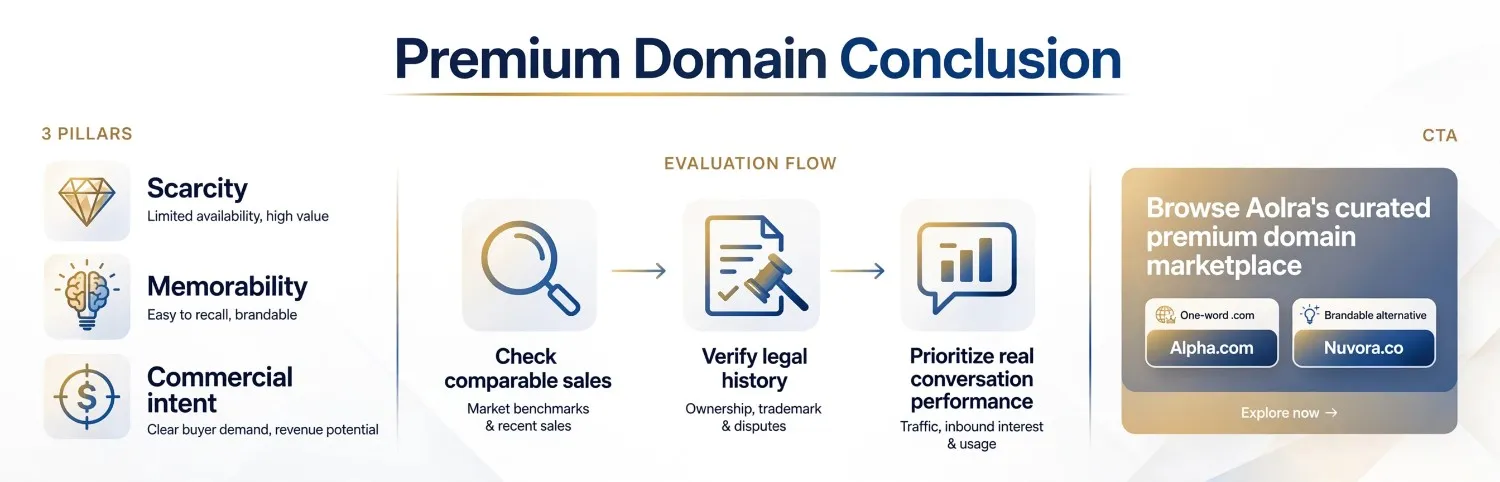
Understanding what is a premium domain name comes down to recognizing that price reflects scarcity, memorability, and commercial intent, not just the registrar’s listing page. Whether the goal is a one-word .com or a shorter, more affordable brandable alternative, the fundamentals of evaluation stay the same: check comparable sales, verify legal history, and prioritize how the name performs in real conversation, not just on a spreadsheet. For founders ready to move forward, to find a name that fits both the budget and the brand.