
Premium domain startup branding means acquiring a short, real-word or near-real-word domain instead of an invented, hard-to-spell name. Founders increasingly favour this route because a premium domain compresses the time and ad spend needed to build recall, while a clever coined name usually demands years of repetition before it means anything. The result is a measurable shift: seed-stage teams are now budgeting for domain quality the same way they budget for a logo or a pitch deck.
This shift did not happen by accident. As customer acquisition costs climbed across nearly every channel, founders started auditing every dollar spent on brand-building, and the domain line item came under fresh scrutiny. A domain that already sounds like a word – something a customer can hear once on a podcast and type correctly the next morning – removes friction that a clever, abstract name simply cannot. That is precisely the gap a low-cost premium domain marketplace is built to close, by putting brandable, real-sounding names within reach of teams that would otherwise have settled for a name nobody can spell.

What is Premium Domain Startup Branding?
Premium domain startup branding is the practice of anchoring a company’s identity to a domain name that already carries linguistic weight – short, pronounceable, and close enough to a real word that people intuitively guess the spelling. It stands in contrast to the older startup convention of inventing a name (think dropped vowels or blended syllables) and then spending years and marketing budget teaching the market to recognise it.
In practical terms, it covers three decisions founders make together:
- Domain selection – choosing a 4 to 7 letter name that reads naturally rather than a string that requires explanation.
- Budget allocation – treating the domain as a branding asset with its own line item, not an afterthought purchased minutes before launch.
- Long-term equity – recognising that a strong domain retains resale and recall value even if the company pivots.
Why a Domain Name Is Often a Startup’s First Impression
Before a customer sees your product, logo, or pricing page, they often encounter your domain name first. In many cases, the domain becomes the first indicator of professionalism and trust.
A short, intuitive domain immediately communicates that a company is established and serious about its brand. Conversely, a confusing or difficult-to-spell name can unintentionally create friction before a prospect even reaches the website.
This is why many founders now view the domain not simply as a web address but as an integral part of the customer experience.
Premium Domains Function as Digital Real Estate
Premium domains share many characteristics with prime real estate. They are:
- Limited in supply
- Easy to remember
- Difficult to replace
- Valuable because of scarcity
Just as businesses compete for premium physical locations, startups increasingly compete for memorable digital locations that can support long-term growth.
Why Startups Are Moving Away From Clever, Invented Names
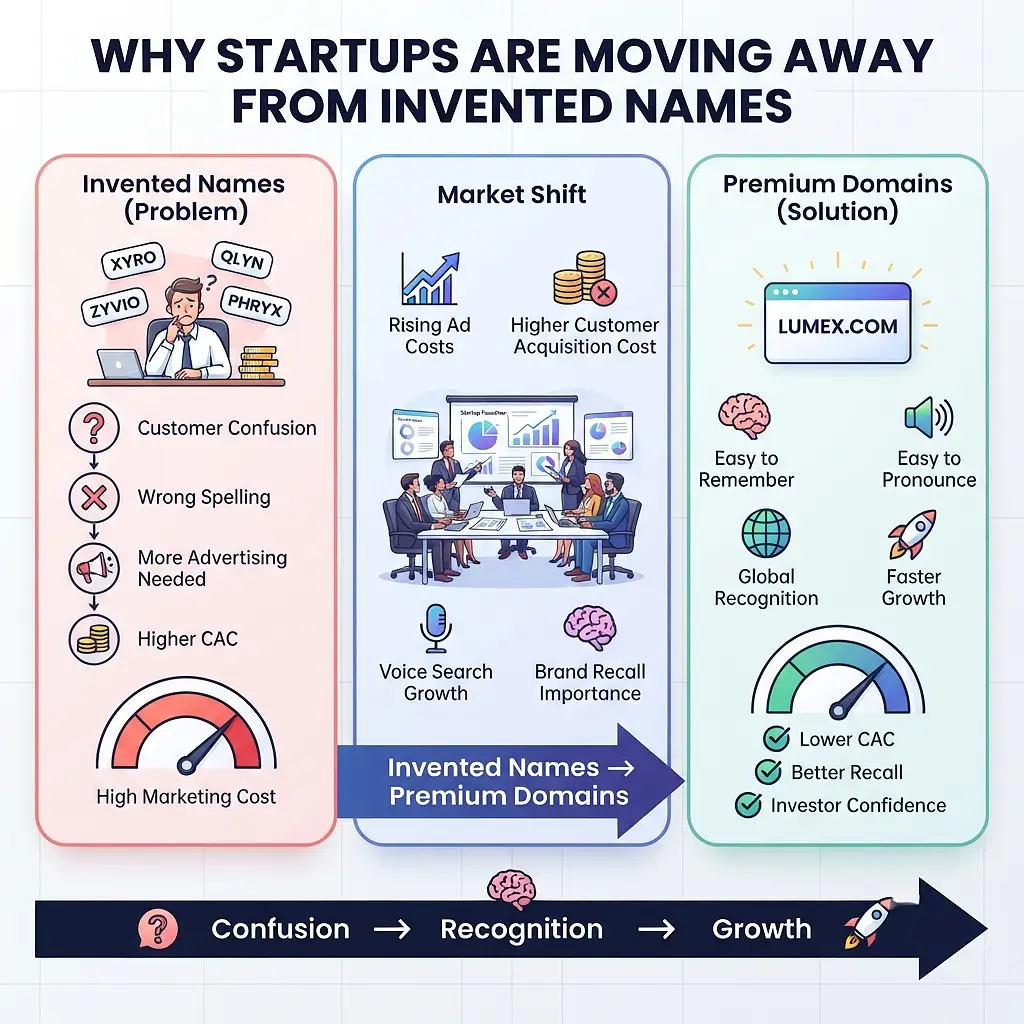
For most of the last decade, the go-to startup naming playbook was to invent a word: drop a vowel, mash two nouns together, or lean on a .ly or .io extension to skirt around an unavailable .com. That approach worked when digital ad costs were low and organic word-of-mouth carried a new name a long way. Neither condition holds today.
Rising Customer Acquisition Costs Changed the Math
Paid channels have become considerably more expensive, so founders can no longer rely on unlimited ad repetition to teach the market an invented name. A domain that already sounds familiar shortens that education curve, which is why premium domain startup branding has moved from a nice-to-have to a budgeted line item during the earliest planning stages.
Investors Now Scrutinise Brand Fundamentals
Seed and Series A investors increasingly review a startup’s domain and brand assets alongside its metrics, since a memorable domain signals that the founding team thought carefully about go-to-market execution, not only product. Consequently, teams that once treated the domain as a formality now research options the same way they research their tech stack, often starting with guidance like this walkthrough on how to buy a premium domain without overpaying.
Voice Search and Verbal Recall Favour Real Words
Voice assistants, podcast mentions, and word-of-mouth referrals all depend on a name being easy to say and spell on the first attempt. Invented names with unusual letter clusters routinely fail this test, whereas dictionary-adjacent premium domains pass it by design.
Consumer Attention Is More Limited Than Ever
Modern consumers encounter thousands of brand messages every day. As attention spans become shorter, companies have less time to make a lasting impression.
A simple, familiar domain often reduces the cognitive effort required to remember a brand. This can improve:
- Brand recall
- Direct traffic
- Referral efficiency
- Customer trust
The easier a name is to remember, the fewer marketing touchpoints are required before customers recognize it.
The Real Cost Comparison: Premium Domains vs. Clever Alternatives
The table below breaks down where the money actually goes under each approach, based on typical early-stage spending patterns.
| Cost Factor | Inexpensive Premium Domain | Clever / Invented Name |
|---|---|---|
| Upfront domain cost | Moderate, one-time | Often near-zero (new registration) |
| Brand education spend (Year 1) | Lower – name is self-explanatory | Higher – market must learn the name |
| Spelling-related lost traffic | Minimal | Common, especially on mobile and voice |
| Trademark and legal clearance risk | Generally lower | Can be higher for coined marks |
| Resale or pivot value | Retains value | Often worthless outside original brand |
Common Mistakes Startups Make When Choosing a Domain
Even founders who understand the value of premium domain startup branding still trip over a handful of avoidable errors:
- Chasing the exact match instead of the brandable match. Holding out for one specific keyword-exact domain often means missing an equally strong, more affordable alternative.
- Ignoring domain history. Skipping a background check on prior ownership or backlink profile can import unwanted baggage, including past penalties.
- Underestimating verbal clarity. A name that reads fine on a slide can still confuse people when spoken aloud, particularly across accents.
- Treating the domain purchase as a last-minute task. Waiting until days before launch limits negotiating room and rushes due diligence.
- Overlooking appraisal fundamentals. Founders who do not understand how domain appraisal tools calculate premium value frequently overpay or undervalue an available name.
Expert Tips for Choosing an Inexpensive Premium Domain
- Prioritise domains that pass the “radio test” – say it out loud to five people and see how many spell it correctly.
- Favour four to seven letter names over longer strings; shorter names consistently perform better for recall and typing accuracy.
- Check that the name reads clean across major social handles before committing.
- Budget the domain purchase into the same round as your logo and initial website build, rather than as a separate afterthought.
- Compare at least three marketplace listings before buying, since pricing for comparable letter combinations varies significantly across platforms.
- Revisit the fundamentals if you are new to the space; this guide on buying a premium domain name cheap covers negotiation tactics most first-time buyers miss.
Step-by-Step: Evaluating a Premium Domain Before You Buy
- Define your naming criteria. Decide on acceptable length, whether a hyphen or made-up spelling is allowed, and which extensions you’ll consider.
- Shortlist five to ten candidates. Pull options from a curated, low-cost premium domain marketplace rather than relying solely on registrar search suggestions.
- Run a history and appraisal check. Confirm the domain has clean ownership records and a fair market valuation.
- Test pronunciation and spelling. Read each candidate aloud to colleagues unfamiliar with the project.
- Negotiate and finalise. Confirm total cost, including any transfer support, before completing the purchase.
Create a Scoring Framework
Professional buyers often score domains using weighted criteria such as:
| Criteria | Weight |
|---|---|
| Brandability | 30% |
| Memorability | 25% |
| Pronunciation | 20% |
| Market Flexibility | 15% |
| SEO Potential | 10% |
Using a structured scoring process helps reduce emotional decision-making and improves consistency.
Premium Domains vs. Clever Alternatives: Quick Comparison
| Attribute | Premium Domain | Clever/Invented Name |
|---|---|---|
| Time to market recognition | Shorter | Longer |
| Spelling accuracy on first try | High | Variable, often low |
| Perceived credibility with investors | Generally higher | Depends heavily on execution |
| Long-term brand equity if pivoting | Retained, resalable | Frequently lost |
Practical Insights From Early-Stage Founders
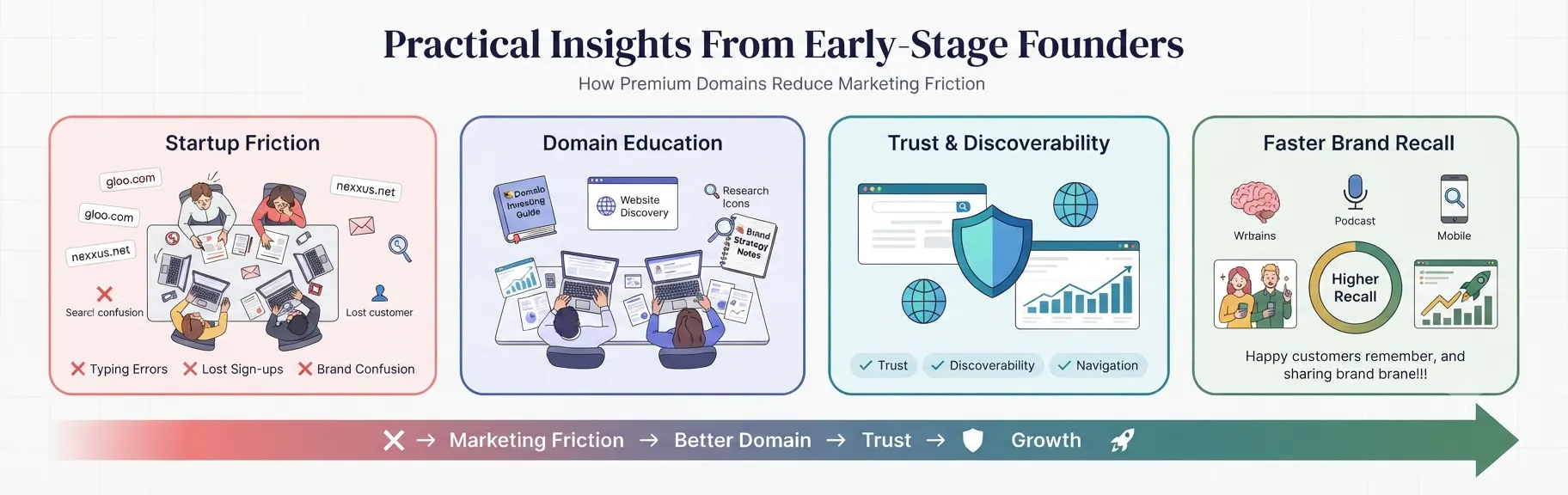
Founders who have gone through both approaches consistently report the same pattern: a premium domain removes a category of marketing friction entirely, rather than merely reducing it. New hires, partners, and press contacts stop mis-typing the company name in emails and search bars, which sounds minor until you tally the lost sign-ups over a full year. For teams still exploring the category, a broader primer such as this beginner’s overview of domain investing for beginners on low-cost premium names is a useful starting point before shortlisting candidates.
Industry data on naming and branding decisions is also increasingly referenced in academic and trade research. Analysis published by the Internet Corporation for Assigned Names and Numbers continues to track how domain naming conventions influence trust and navigation online, while ongoing guidance from Google Search Central’s SEO fundamentals reinforces that a clear, descriptive site identity supports long-term discoverability. Branding researchers at outlets such as the Harvard Business Review have likewise documented how simpler, more pronounceable brand names correlate with faster consumer recall.
How Premium Domains Influence Brand Trust
Trust is difficult to measure but extremely important.
Consumers often make assumptions based on brand presentation. Short, professional domains can create impressions of:
- Credibility
- Stability
- Professionalism
- Authority
Even small improvements in trust can positively affect conversion rates and customer engagement.
Frequently Asked Questions About Premium Domain Startup Branding
What does “premium domain startup branding” actually mean?
It refers to building a startup’s identity around a short, real-word or near-real-word domain rather than an invented name, so the brand carries built-in recall and pronounceability from launch.
Is an inexpensive premium domain really better than a free, invented name?
In most cases, yes, because the ongoing cost of teaching the market an unfamiliar invented name usually exceeds the upfront cost of a premium domain over the startup’s first two to three years.
How much should a startup budget for a premium domain?
Budgets vary by desired length and category, but curated marketplaces focused on low-cost inexpensive premium domains typically offer brandable four to seven letter names well below traditional aftermarket pricing.
Can a premium domain help with SEO as well as branding?
A premium domain supports SEO indirectly through stronger brand-search behaviour, direct type-in traffic, and trust signals, though it works best alongside genuinely useful content rather than as a substitute for it.
What is the biggest risk of skipping premium domain startup branding?
The main risk is spending disproportionately more on paid advertising and repetition marketing later, simply to compensate for a name that customers cannot easily recall or spell.
The Opportunity Cost of Choosing the Wrong Name
The biggest cost of a weak domain is rarely the registration fee.
Instead, the real cost often appears through:
- Lost direct traffic
- Lower referral rates
- Higher advertising spend
- Slower brand recognition
- Reduced investor confidence
These opportunity costs can compound for years, making early naming decisions far more important than they initially appear.
Building Your Startup on a Name That Works From Day One
Premium domain startup branding is no longer a luxury reserved for well-funded companies; it has become a practical, budget-conscious decision available to any founder willing to shop carefully. The startups pulling ahead are not necessarily the ones with the cleverest invented names – they are the ones whose domain does half the branding work before a single ad dollar is spent. If your company is still operating on a name that needs explaining,
Pingback: Domain Buying Regret: 10 Purchases That Backfired