
Domain buying regret happens when a buyer acquires a domain name without verifying its trademark status, traffic history, backlink profile, or true market value, and only discovers the problem after the purchase closes. In nearly every documented case, at least one red flag – an inflated appraisal, a vague seller history, a hidden legal dispute, or a rushed negotiation – was visible before the sale but ignored under pressure to “lock in” the name. Understanding these patterns is the fastest way to buy with confidence instead of hindsight.
Every year, thousands of entrepreneurs and investors buy a domain they later wish they hadn’t. Sometimes the mistake costs a few hundred dollars. Other times, it costs a rebrand, a lawsuit, or a business’s entire online identity. If you’re evaluating a purchase through a curated premium domain marketplace built for careful buyers, you already have an advantage – but the marketplace can only do so much if the red flags get waved away in the excitement of a deal.


This guide walks through ten real categories of domain buying regret, the warning signs buyers routinely dismiss, and the practical steps that separate a smart acquisition from an expensive lesson. Whether you’re buying your first domain or your fiftieth, these patterns repeat often enough that they’re worth memorizing.
What is Domain Buying Regret? (Quick Definition)
Domain buying regret is the seller’s remorse equivalent for domain name acquisitions: the moment a buyer realizes, often weeks or months after the transaction, that the domain they purchased carries a hidden liability, an inflated price, or a fundamental mismatch with their brand goals.
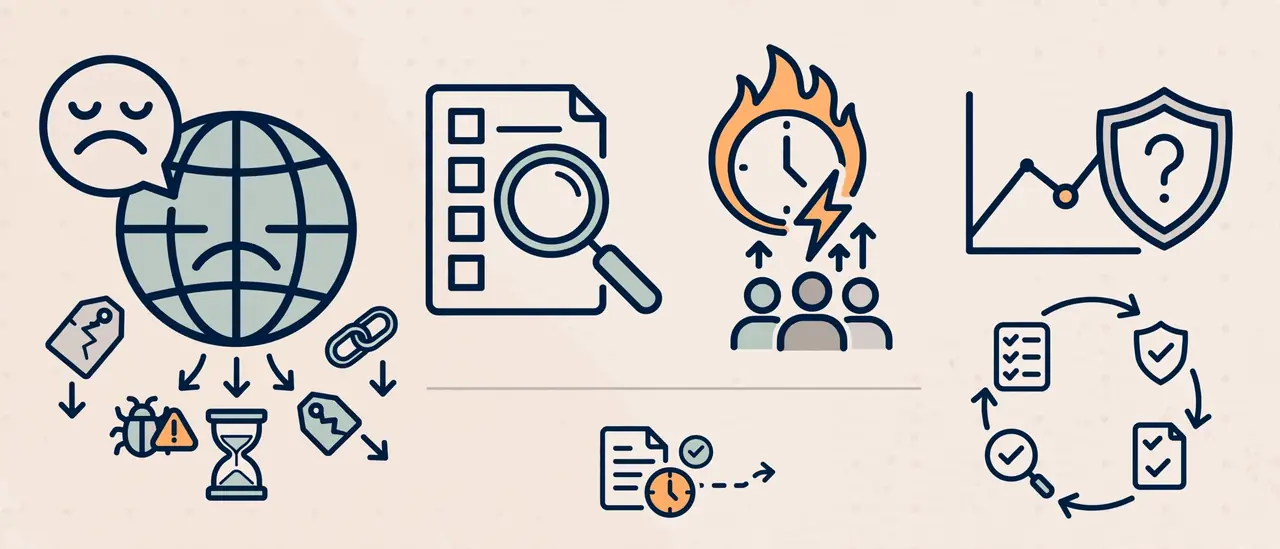
It typically stems from one of three root causes:
- Insufficient due diligence before the offer was made
- Emotional urgency created by scarcity tactics or bidding pressure
- Overreliance on a single data point (like a valuation tool score) instead of a full risk assessment
Recognizing which category a regret falls into makes it much easier to prevent the next one. Most buyers assume regret comes from bad luck – a hidden issue no one could have caught. In practice, the overwhelming majority of documented cases trace back to information that was available at the time of purchase but simply wasn’t checked, because checking felt slower than the deal’s momentum allowed.
That distinction matters because it changes how you should approach every future purchase. Instead of hoping to get lucky, you can build a short, repeatable verification habit that catches the same red flags every time – regardless of how exciting or time-pressured a specific listing feels.
Why Domain Buying Regret is More Common Than Buyers Admit
Domain marketplaces move fast, and that speed works against careful decision-making. A buyer sees a name that fits their brand, checks one appraisal tool, and submits an offer within minutes. Compare that to buying a used car, where most people research history reports, get an inspection, and negotiate over days – a domain, despite sometimes costing more, rarely gets the same scrutiny.
This mismatch between price and process is exactly why learning what makes a domain valuable in the first place matters before you ever open a listing. Buyers who understand what actually defines a premium domain name are far less likely to overpay for length, keywords, or extension alone.
10 Domain Purchases Buyers Regret – And the Red Flags They Ignored
1. The “Perfect Match” Domain With a Trademark Conflict

A founder finds a domain that matches their brand name exactly, buys it within hours of discovering it, and launches a website. Months later, a cease-and-desist letter arrives from a company holding a registered trademark on the same term in their industry.
Red flag ignored: No trademark search was run in the target country or industry class before purchase.
Prevention: Run a trademark database check (national and international) before finalizing any brand-matching domain, especially in competitive niches like law, finance, or consumer products.
Long-term impact: Beyond the legal fees, the buyer often has to rebrand every printed asset, social profile, and paid campaign that referenced the disputed name – a cost that dwarfs the original purchase price. Trademark-sensitive industries almost always require this extra layer of screening before a domain is ever listed for sale.
2. The Bargain Domain With a Manipulated Traffic History

A domain listed as “high-traffic, aged, SEO-ready” sells for a premium because of its reported visitor numbers. After purchase, the buyer discovers the traffic came from a short-lived viral event years earlier and has been effectively zero since.
Red flag ignored: Traffic screenshots weren’t cross-verified against independent analytics tools or archive snapshots.
Prevention: Always request a live analytics screen-share or verify historical traffic through third-party tools like Wayback Machine and independent SEO trackers rather than relying on seller-provided screenshots.
Long-term impact: Once the inflated traffic story unravels, the resale value of the domain often falls sharply, leaving the buyer holding an asset worth far less than what they paid and with no realistic way to recover the premium at resale.
3. The Auction-Fever Purchase

A bidding war pushes a domain’s price to three or four times its realistic market value. The winning buyer feels a rush of victory – until an independent appraisal a week later reveals they paid well above comparable sales.
Red flag ignored: No comparable sales research was done before entering the auction; the buyer let competing bids set the price ceiling instead of market data.
Prevention: Before bidding, review how record-breaking domain sales actually get priced so you understand which factors genuinely justify a premium and which are auction adrenaline.
Long-term impact: Overpaying in an auction doesn’t just hurt at checkout – it raises the bar for break-even resale, meaning the buyer may need to hold the domain far longer than planned just to avoid a loss.
4. The Expired-Domain “Steal” With a Spam Penalty

An investor buys a recently expired domain because of its strong backlink count and clean-looking niche relevance. Weeks later, none of the new content ranks – the domain was previously used for a link farm and carries a manual action or algorithmic penalty from Google.
Red flag ignored: Backlink profile was checked for quantity but not quality, and no manual review of anchor text patterns was performed.
Prevention: Audit the backlink profile for spammy anchor text, irrelevant link networks, and prior use in schemes explicitly discouraged in Google’s own webmaster guidelines before treating “backlinks included” as a selling point.
Long-term impact: Recovering from a manual action or algorithmic demotion can take months of disavow requests and content rebuilding, during which the domain generates no organic value at all – effectively erasing the reason it was bought in the first place.
5. The Overpriced Single-Word Domain in a Shrinking Niche

A buyer pays a five-figure sum for a short, brandable, single-word domain tied to an industry that’s visibly declining. Two years later, resale interest is nonexistent because the underlying market has contracted.
Red flag ignored: No forward-looking analysis of industry growth trends accompanied the appraisal – only the domain’s linguistic qualities were assessed.
Prevention: Pair any valuation with independent research into the market’s five-year outlook, not just the word’s brandability score.
Long-term impact: A domain tied to a shrinking niche becomes progressively harder to resell every year, since fewer buyers are actively searching that category – turning what looked like an investment into a depreciating, illiquid asset.
6. The Country-Code Domain Bought Without Understanding Local Restrictions

A buyer purchases a country-code top-level domain (ccTLD) assuming it functions exactly like a .com. They later learn the registry requires local presence, business registration, or annual renewal documentation they don’t have – putting the domain at risk of cancellation.
Red flag ignored: Registry-specific eligibility rules weren’t reviewed before purchase.
Prevention: Confirm ownership and renewal requirements directly with the relevant registry or a knowledgeable registrar before buying any ccTLD.
Long-term impact: Non-compliant ccTLD registrations can be suspended or reclaimed by the registry with little warning, which means the buyer risks losing the domain entirely, along with any brand equity or backlinks built on it.
7. The “Cheap Premium” Domain That Was Actually a Typo Trap

A buyer grabs what looks like an unusually affordable premium domain, only to realize post-purchase that it’s a common misspelling of a well-known brand – making it legally risky and functionally useless for building an independent audience.
Red flag ignored: The buyer didn’t compare the domain against major existing brand names in adjacent industries.
Prevention: Before assuming a domain is genuinely an inexpensive premium option for startup branding, confirm it isn’t priced low because it’s a disguised trademark risk rather than a genuine bargain.
Long-term impact: Typo-adjacent domains frequently trigger takedown requests or UDRP disputes once a brand notices the traffic overlap, meaning the buyer often loses both the domain and any content built on it.
8. The Rushed Purchase Without an Escrow Service

Eager to close quickly, a buyer wires payment directly to a seller outside of any escrow arrangement. The seller never transfers the domain, and the buyer has no recourse because there’s no documented, neutral third party holding funds until transfer confirmation.
Red flag ignored: No escrow or verified transfer protocol was used, despite the seller being unfamiliar or unverified.
Prevention: Always use a licensed domain escrow service, and understand the standard domain transfer process so you know what a legitimate transfer sequence actually looks like.
Long-term impact: Without escrow, a failed transfer usually means the funds are simply gone, with no chargeback, dispute process, or registrar mechanism able to reverse the loss.
9. The Startup Domain Bought Before the Business Plan Existed

A founder buys a domain purely because it sounds catchy, before defining their target market, product positioning, or brand voice. Once the business plan solidifies, the domain no longer fits – and the founder either rebrands at a loss or forces a mismatched name onto the business.
Red flag ignored: The purchase decision was made before any naming strategy or brand framework existed.
Prevention: Review why startup naming and domain strategy should come before the business plan, not after, so the domain reinforces the brand rather than constraining it.
Long-term impact: A mismatched domain often forces founders to choose between an expensive mid-growth rebrand or years of explaining a name that no longer represents the business.
10. The Investment Domain Bought on Appraisal Score Alone

An investor purchases a domain purely because an automated appraisal tool assigned it a high dollar value. The tool’s algorithm weighted keyword length and extension heavily but didn’t account for actual buyer demand in that specific niche – and the domain sits unsold for years.
Red flag ignored: A single automated score was treated as a guarantee of resale value instead of one data point among several.
Prevention: Understand how domain appraisal tools actually calculate value so you can weigh algorithmic scores against real transaction comparables and genuine market demand.
Long-term impact: Capital tied up in an unsellable domain can’t be redeployed into better opportunities, so the real cost isn’t just the purchase price – it’s the years of lost investment flexibility.
The Real Cost of Domain Buying Regret
The purchase price is rarely the full cost of a regretted domain. When you add up the secondary expenses, the true price tag looks very different:
- Legal fees from responding to trademark disputes or UDRP complaints
- Rebranding costs including new logos, packaging, business cards, and paid ad accounts
- Lost SEO momentum while a penalized or low-quality domain gets cleaned up or abandoned
- Opportunity cost of capital that could have funded a better-vetted acquisition
- Time cost spent negotiating refunds, disputing chargebacks, or pursuing escrow claims that were never set up correctly
None of these costs show up in the original listing price, which is exactly why they catch buyers off guard. A domain that looked like a bargain at checkout can end up being the most expensive purchase in a founder’s entire brand-building budget once these secondary costs are added in.
Comparison Table: Regret Type vs. Red Flag vs. Prevention Step
| Regret Category | Ignored Red Flag | Prevention Step |
|---|---|---|
| Trademark conflict | No legal search performed | Run trademark database checks pre-purchase |
| Manipulated traffic | Unverified analytics screenshots | Cross-check with independent tools |
| Auction overpay | No comparable sales research | Study historical sale prices first |
| Spam-penalized backlinks | Quantity checked, not quality | Audit anchor text and link sources |
| Declining-niche overpay | No market trend analysis | Research five-year industry outlook |
| ccTLD restrictions | Registry rules unread | Confirm eligibility with the registry |
| Typo-trap domain | No brand comparison done | Check against major existing trademarks |
| No escrow used | Direct payment to unverified seller | Use licensed escrow services only |
| Domain before business plan | No naming strategy defined | Build brand framework before buying |
| Appraisal-only investment | Single data point trusted | Combine appraisal with market comparables |
Common Mistakes That Lead to Domain Buying Regret

Beyond the ten specific scenarios above, several habits show up repeatedly across regretful purchases:
- Treating a single valuation tool as the final word on price. Algorithmic appraisals are a helpful starting point, not a guarantee, and leaning on one score alone leaves buyers blind to real market demand.
- Skipping WHOIS history and prior-ownership research. A domain’s past life – who owned it, how it was used, and why it was sold – often explains risks that the current listing doesn’t mention.
- Negotiating under artificial urgency created by “other buyers are interested” messaging. Scarcity language is a common negotiation tactic, and reacting to it instead of your own research is how overpaying happens.
- Failing to confirm the seller actually owns the domain before sending funds. Ownership verification through the registrar takes minutes and prevents one of the most damaging forms of domain fraud.
- Ignoring extension-specific risks (ccTLD rules, new gTLD renewal terms). Every extension has its own eligibility and renewal framework, and assuming they all work like a .com is a frequent, costly assumption.
- Buying based on emotional attachment to a word rather than commercial demand. A name that feels perfect to the buyer doesn’t always translate into resale interest or brand recognition for customers.
Expert Tips for Buying Without Regret
Industry veterans consistently recommend a short, repeatable checklist before any domain purchase closes:
- Verify legal standing – run a trademark and business-name search in your target market before you get emotionally invested in a name.
- Confirm technical history – check WHOIS records, Wayback Machine snapshots, and backlink quality so you know exactly what you’re inheriting, not just what the listing describes.
- Cross-reference valuation – compare at least two independent appraisal sources plus recent comparable sales, since any single tool can be skewed by factors that don’t reflect real buyer demand.
- Use secure transfer channels – insist on escrow and a documented transfer timeline, and never wire funds directly to a seller you can’t independently verify.
- Separate excitement from strategy – if you haven’t defined your brand positioning yet, wait before buying, since a domain chosen before the strategy exists rarely fits the strategy once it’s finalized.
- Budget for the full acquisition, not just the sticker price – factor in escrow fees, potential legal review, and transfer costs so the final number reflects the true investment.
If you’re new to this process, starting with a beginner’s guide to low-cost premium domain investing is a practical way to build this checklist habit from day one.
How to Spot a Red Flag Before You Bid

Most domain buying regret is preventable simply by slowing down at the exact moment sellers want you to speed up. A few negotiation-stage warning signs deserve extra scrutiny:
- Vague ownership history. If a seller can’t clearly explain who has owned the domain and for how long, that ambiguity is itself a red flag worth investigating further before any offer is made.
- Reluctance to share verifiable data. A legitimate seller should have no problem letting you cross-check traffic, backlinks, or registration history through independent tools rather than only their own screenshots.
- Pressure to skip escrow “to save time.” Any request to bypass a licensed escrow service, regardless of the reason given, should be treated as disqualifying rather than a minor inconvenience.
- Appraisal numbers that don’t match comparable sales. When a listed price is dramatically higher than recent, similar transactions, ask why – and don’t accept “brandability” as the only justification.
- Inconsistent extension or registrar details. Discrepancies between what a listing claims and what the registrar’s public record shows are worth resolving before you negotiate further, not after you’ve paid.
Buyers who train themselves to notice these signals during negotiation, rather than after the domain is already transferred, consistently report far fewer post-purchase surprises. It’s a habit built over a handful of deals, not an innate skill – which is exactly why a written checklist matters more than instinct alone.
Step-by-Step Guidance: A Pre-Purchase Due Diligence Checklist
- Identify the domain and confirm the exact seller and registrar of record.
- Run a trademark and business-registry search in relevant jurisdictions.
- Pull WHOIS history and archived snapshots to understand prior use.
- Verify traffic and backlink claims independently, not just through seller screenshots.
- Compare at least three recent comparable sales in the same niche and length category.
- Confirm any extension-specific renewal or eligibility requirements.
- Arrange payment through a licensed escrow service.
- Document the agreed transfer timeline and registrar-to-registrar steps before paying.
Quick Comparison: Rushed Purchase vs. Vetted Purchase
| Factor | Rushed Purchase | Vetted Purchase |
|---|---|---|
| Trademark check | Skipped | Completed before offer |
| Traffic verification | Seller screenshots only | Independent tool cross-check |
| Price benchmarking | Single appraisal score | Multiple comparables reviewed |
| Payment method | Direct transfer | Licensed escrow |
| Post-purchase outcome | High regret risk | Low regret risk |
How Aolra Helps Buyers Avoid These Mistakes
A marketplace’s job isn’t just to list names – it’s to make the red flags visible before you commit. When you browse Aolra’s marketplace of vetted, reasonably priced premium domains, you’re working from listings built around transparent history and realistic pricing rather than inflated urgency. Pairing that transparency with the checklist above is the most reliable way to buy a domain you’ll still be glad you own a year from now.

For further verification during your own due diligence, buyers can also consult official resources such as ICANN’s registrant resources for confirming registry and registrar obligations, and review Google’s own guidance on link spam when auditing a domain’s backlink history for spam penalties. Trademark status can be checked directly through a national intellectual property office’s public search database before any brand-matching domain purchase is finalized.
Frequently Asked Questions
What is domain buying regret?
Domain buying regret is the realization, usually after a purchase closes, that a domain carries a hidden legal, technical, or valuation problem that wasn’t caught during due diligence.
What’s the most common cause of domain buying regret?
Skipping independent verification – of trademark status, traffic history, or backlink quality – and relying solely on seller-provided information or a single appraisal score.
How can I avoid domain buying regret before purchase?
Run a trademark search, verify traffic and backlinks independently, compare recent comparable sales, and always use a licensed escrow service for payment.
Is buying an expired domain riskier than buying a new one?
It can be, since expired domains may carry undisclosed spam penalties or manipulated backlink histories that only surface after independent auditing.
Should I trust an automated domain appraisal tool completely?
No. Treat automated appraisals as one data point among several, and always cross-reference them with real comparable sales and current market demand.
Does domain buying regret only affect first-time buyers?
No. Experienced investors fall into these patterns too, usually during auctions or bulk purchases when the pace of decision-making outruns the due diligence process.
How long does it typically take to recover from a bad domain purchase?
It varies by regret type – a spam-penalty cleanup can take several months, while a trademark dispute or failed transfer may take considerably longer to resolve, which is exactly why prevention is far cheaper than recovery.
Conclusion
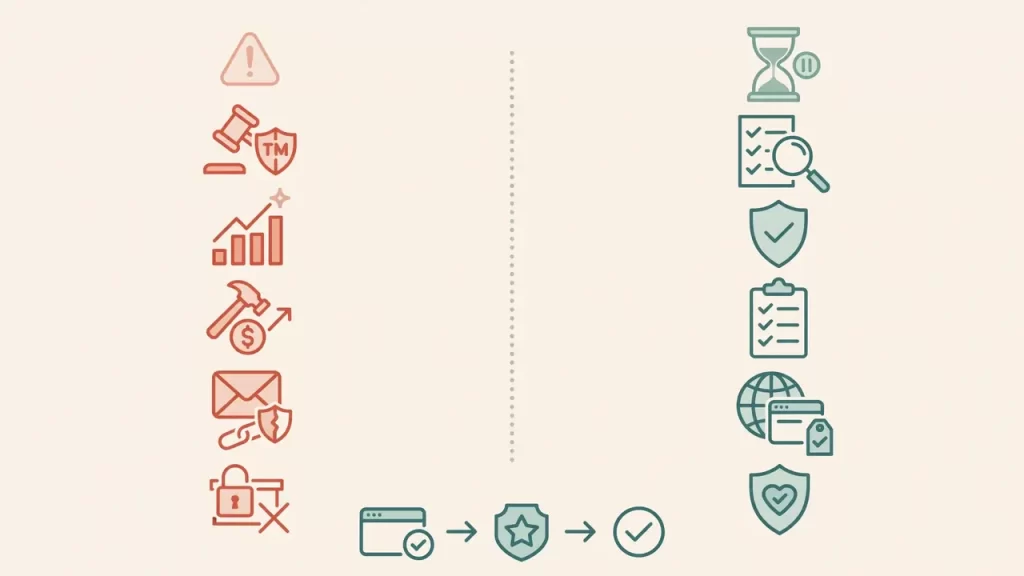
Domain buying regret is rarely caused by bad luck – it’s almost always caused by a visible red flag that got overlooked in the rush to close a deal. Trademark conflicts, inflated traffic claims, auction-fever overpaying, spam-penalized backlinks, and skipped escrow steps are all preventable with a short, repeatable due diligence process. The buyers who avoid regret aren’t the ones with insider information; they’re the ones who slow down long enough to verify what the listing actually claims.
If you’re ready to buy with that same discipline, explore Aolra’s curated selection of low-cost premium domains and start your next purchase with the checklist, not just the excitement. The buyers who look back on a domain purchase with satisfaction, rather than regret, are almost never the ones who moved fastest – they’re the ones who paused just long enough to confirm what the listing actually promised.